Research Article | | Peer-Reviewed

Effectiveness of Mepiquat Chloride Application Timing on Physiological, Agronomic, and Fiber Quality Traits of Cotton (Gossypium spp.) Varieties

Received: 2 April 2026     Accepted: 13 April 2026     Published: 24 April 2026
Views:       Downloads:
Abstract

A two-year field study underscores the importance of integrating genotype selection with optimized Mepiquat Chloride (MC) management to enhance cotton performance under a split–split–plot design. Significant genotype × environment × management interactions were observed in cotton growth, yield, and fiber quality responses MC application. Plant height was significantly affected by year × variety interaction (p < 0.01), with the tallest plants in Selin (2023) and Sezener (2022). Leaf area was higher in 2022, while 800 cc. ha-1 enhanced leaf expansion. Monopodial branches were significantly greater in 2023 (9.59 plant-1), with early MC application favoring branch initiation. Seed cotton yield was peak in Selin (3623 kg ha-1), 25% greater than Sezener, with split application (400 + 400 cc. ha-1) yielding best results. Boll number and individual fiber weight were higher in Selin and Sezener, respectively, with the latter showing a 48% increase under 400 cc. ha-1. Seed index was significantly higher in Sezener, and fiber moisture increased in 2023 (8.94%). Fiber quality traits revealed pronounced year, genotype, and application timing effects: fiber length peaked in Sezener (30.33 mm), elongation reached 5.80%, and micronaire increased to 4.89 µg inch-1 under split MC application. Fiber strength increased by 13.07% in 2023, and while uniformity (85.62%) maximized with later application. Short fiber content decreased by 14.81% in 2023. These findings highlight that MC concentration, timing, and genotype interactions significantly modulate morphophysiological traits, yield components, and fiber quality, with split or moderate-dose applications enhancing productivity and fiber properties under Mediterranean conditions.

Published in International Journal of Applied Agricultural Sciences (Volume 12, Issue 2)
DOI 10.11648/j.ijaas.20261202.15
Page(s) 54-73
Creative Commons

This is an Open Access article, distributed under the terms of the Creative Commons Attribution 4.0 International License (http://creativecommons.org/licenses/by/4.0/), which permits unrestricted use, distribution and reproduction in any medium or format, provided the original work is properly cited.

Copyright

Copyright © The Author(s), 2026. Published by Science Publishing Group

Keywords

Cotton, Morphophysiological, MC, Timing, Quality Traits, Yield Components

1. Introduction
Cotton (Gossypium hirsutum L.), a major cash crop of the Malvaceae Family, is cultivated in more than 70 countries, particularly across tropical and subtropical regions . It holds substantial industrial and commercial importance and serves as a vital and sustainable source of income and employment for millions of smallholder farmers worldwide . Its fibers contribute approximately 81% of the raw materials used in the global textile industry , while its seeds serve as a major source of edible oils and livestock feed .
Despite substantial advancements in cotton production technologies, global productivity remains suboptimal due to the complex interplay of agronomic, climatic, environmental, socio-economic, and political factors . Although cotton thrives in high-temperature environments—ideally between 40°C and 45°C—and is inherently suited for heat-prone regions , its productivity is increasingly constrained by the intensifying impacts of climate change . Major stressors such as erratic rainfall, prolonged drought, rising temperatures, and evolving pest and disease pressures have collectively disrupted the crop’s growth cycles, physiological stability, and reproductive development . These challenges are especially detrimental during sensitive phenological stages, ultimately leading to significant yield reductions and threatening the long-term sustainability of cotton-based farming systems .
In climate-stressed countries such as China, India, the United States, Brazil, Pakistan, and Turkey, early-maturing cotton varieties have been increasingly adopted as an adaptive strategy, owing to their shorter growth cycles and lower water requirements . However, while early-maturing genotypes offer advantages under water-limited and heat-stressed conditions, tend to exhibit excessive vegetative growth when environmental conditions are favorable, often at the expense of reproductive development . This vegetative-reproductive imbalance leads to poor boll retention, delayed maturity, and ultimately reduced fiber yield and quality . Yield losses of 6–10% per 1°C rise above optimal temperatures (~30–32°C) have been reported, underscoring the urgency of developing adaptive strategies for sustaining productivity under warming conditions .
One promising approach to mitigate heat-induced vegetative–reproductive imbalance is the use of plant growth regulators, particularly mepiquat chloride (MC), a quaternary ammonium (N, N-dimethylpiperidinium chloride) compound that inhibits gibberellin biosynthesis . By restricting stem elongation, reducing node production, and promoting a more compact canopy architecture, MC can reallocate assimilates from vegetative to reproductive sinks . Numerous studies have demonstrated its ability to enhance boll retention, increase boll number and weight, and improve fiber quality under conventional production conditions . However, its efficacy appears strongly influenced by genotype, dose, timing, and environmental conditions .
Evidence from controlled-environment experiments shows that MC’s growth-suppressing effects are temperature sensitive . At moderate day/night regimes (~32–35°C), MC markedly reduces plant height, node number, and leaf expansion, while increasing fruit retention . Under more severe heat (≥39°C), these effects diminish, and higher doses are required to maintain even partial growth control . Field studies in water-limited or high-radiation environments similarly report yield gains of 15–34% and improvements in boll retention and fiber traits (micronaire, strength, length, and uniformity) when MC is combined with nitrogen fertilization or applied at optimal growth stages . Nevertheless, the magnitude of these benefits is inconsistent and tends to decline under intense heat stress .
While MC shows potential as a tool for moderating heat-related yield losses, its ability to stabilize fiber quality under such conditions remains unclear. Most available data come from studies on mid- to late-maturing cultivars grown under non-stress conditions, with limited evidence from early-maturing genotypes commonly cultivated in the Mediterranean region of Turkey. Moreover, the dose × application timing × environmental conditions interaction governing MC effectiveness has not been systematically quantified, and the genetic variation in cotton responsiveness to MC under climate-stressed conditions is poorly understood.
Addressing these knowledge gaps is critical for developing climate-resilient cotton production systems. Specifically, there is a need to (i) define agro-meteorological thresholds beyond which MC loses efficacy, (ii) optimize its timing and dosage relative to concurrent heat + drought episodes, and (iii) evaluate genotypic differences in yield and fiber quality responses to MC under stress-prone field conditions. Such insights will enable the strategic integration of MC into adaptive management packages potentially in combination with adjusted sowing dates, irrigation scheduling, and canopy management practices to sustain cotton yield and fiber quality in the warming Mediterranean basin.
2. Materials and Methods
2.1. Description of the Study Site
The experiment took place during the 2022 and 2023 cropping years at the Eastern Mediterranean Agricultural Research Institute, situated at Adana/Turkey (at coordinates 36°51′ N latitude and 35°20′ E longitude). During summer, the Mediterranean region is characterized by warm and mild conditions, with mean monthly temperatures ranging from 20.30 to 30.49°C. Average monthly rainfall during this period varies between 2.20 mm and 41.20 mm, while relative humidity ranges from 40.95% to 54.95% .
2.2. Soil Characteristics of the Study Site
Soil samples were collected from the 0–30 cm profile at the experimental site, and their characteristics were analyzed using air-dried fine earth fractions. Particle size distribution was determined following the method described by . Soil pH (H₂O) was measured according to , while organic carbon content was determined using the Walkley–Black wet combustion method . Phosphorus was analyzed following the procedure of , while calcium (Ca) and potassium (K) contents were determined using an atomic absorption spectrophotometer as described by . The soil characteristics of the experimental site are presented in Table 1.
Table 1. Physicochemical characteristics of the experimental soil profile (0–30 cm depth).

Clay (%)

Silt (%)

Sand (%)

Texture

pH

CaCO3 (%)

EC (ds/m)

P2O5 (kg/ha)

K2O (kg/ha)

Organic Matter (%)

33.7

43.7

22.6

CL

7.89

21.5

1.0

43.3

474.5

0.98

CL Clay Loam, EC Electrical Conductivity, ds/m deciSiemens per metre
2.3. Weather Characteristics
The monthly rainfall during the 2022–2023 cotton growing seasons in the Mediterranean region of Turkey is illustrated in Figure 1. Across the two years, rainfall was well distributed in November but declined markedly in July and September of 2023. The total precipitation during the seven-month growing period was comparable between years, with 172.80 mm in 2023 and 170.20 mm in 2022, aligning with long-term regional climatic data reported by over the past 91 years. Climatic conditions in 2023 were slightly warmer and more humid than in 2022, with mean maximum and minimum temperatures of 32.32°C and 17.40°C, respectively, compared with 31.84°C and 17.12°C in 2022, and mean relative humidity values of 65.70% and 64.39% (Figure 1) .
Figure 1. Selected meteorological variables characterizing the experimental site during the 2022 - 2023 growing seasons.
2.4. Experimental Design and Treatments
A sample layout of a 2 x 2 x 4 factorial experiment arranged in a split-split-plot design with two cultivars (C1 and C2) as main-plot treatments, two spraying intervals (T1 and T2) as subplot treatments, and four Mepiquat Chloride (MC) levels (MC0, MC1, MC2 and MC3) as sub-subplot treatments, in three replications. MC treatments used in this study were MC0 (0 cc. ha-1), MC1 (400 cc. ha-1), MC2 (400 + 400 cc. ha-1) and MC3 (800 cc. ha-1). The cotton cultivars entailed of Selin and Sezener, both of which are early-maturing. The growth regulator and cotton seeds were supplied by the Eastern Mediterranean Agricultural Research Institute. MC rates were applied manually using a calibrated twenty-liter sprayer on entire plots at two growth stages: at squaring (8 weeks after planting [WAP] in both years) and at the boll setting (11WAP in both years).
2.5. Field Management Practices
To enhance soil tilth, disrupt capillary continuity, and suppress weed emergence, tractor hoeing was conducted four times before planting. Plant seeds were sown mechanically in the experimental plots, with each sub-subplot containing four rows, each 3 meters long, with a 70 cm spacing between rows and 20 cm spacing between plants within each row. Planting took place on May 26 in the first year and June 12 in the second year, at a depth of 5 cm below the soil surface. Irrigation was scheduled monthly for the first four months after sowing, resulting in a total of four irrigation events, and was terminated at the boll development stage. Fertilization consisted of the application of nitrogen (N) and phosphorus (P) fertilizers to ensure adequate nutrient supply for crop growth. Nitrogen was supplied at a total rate of 16 kg N ha-1, with half applied as 20-20-0 compound fertilizer prior to sowing and the remaining half as ammonium nitrate (26% N) during the first irrigation. Phosphorus was applied entirely before sowing at a rate of 8 kg P ha-1. Pest management included targeted chemical applications: Movento (150 mL ha-1) for controlling aphids and leafhoppers, Mosplan 20 SP (60 g ha-1) against whiteflies, and Neemarin (60 g ha-1) to suppress green bollworm infestations. All other necessary agronomic practices during the crop growth period were conducted as recommended.
2.6. Data Collection
In the current finding, various parameters, including leaf area per plant, yield, seed index, individual fiber weight, moisture, fiber length, length uniformity, micronaire, spinning coefficient index, and short fiber index, were measured. Leaf area was measured using the Microscopy Image Analysis method (ImageJ software). Three plants were randomly selected from the two central rows, excluding 60 cm from both ends of each row. Leaf area per plant was obtained according to the method of , as indicated in equation (1). When the cotton bolls were fully mature and had opened, they were hand-harvested from ten plants in each plot to assess the seed cotton yield and 100-seed weight. The seed cotton was weighed using a scale with an accuracy of 0.01 g and then converted to kilograms per hectare (kg·ha-1) as indicated in equation (2). The harvested seed cotton was ginned to separate the fibers from the seeds, and then the 100-seed weight was measured using the aforementioned scale. For analyzing fiber characteristics, all fibers were sent to the fiber quality laboratory of the Eastern Mediterranean Agricultural Research Institute for assessment based on quality grade standards, using a fully automated High-Volume Instrument (HVI) device. Individual fiber weight was determined according to the method of , with some modifications, as indicated in equation (3).
Total leaf area per plant = averaged leaf area (cm2) * number of leaves per plant(1)
Seed cotton yield (kg. ha-1) = amount weighed (kg) ×10,000 / number of harvested plants × harvested area in square meters (2)
Individual fiber weight (µg) =[fiber length (cm) x length uniformity (%) x (micronaire * 10,000,000)](3)
2.7. Data Analysis
The analysis of variance was performed using GenStat Discovery software (version 15.1), and mean comparisons were conducted using Duncan`s Multiple Range Test (P<0.05). All graphs were created using Excel software on Windows 21.
3. Results
3.1. Morphological Traits
3.1.1. Plant Height
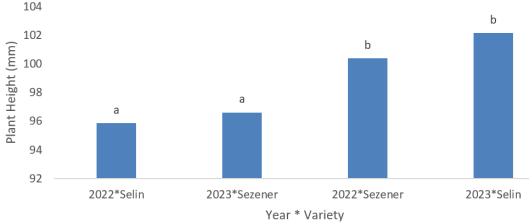
Analysis of variance revealed a statistically significant interaction between year and variety on plant height (P<0.01; Table 2). Post hoc comparisons indicated that the tallest plants were observed in the Selin variety in 2023 (102.14 cm) and the Sezener variety in 2022 (100.40 cm). In contrast, the shortest plants were recorded for the Sezener variety in 2023 (96.61 cm) and the Selin variety in 2022 (95.85 cm) (Figure 2), underscoring the genotype-by-environment interaction effect on vegetative growth.
No significant main effects of year, concentration, variety, or application time were observed on plant height when considered independently (Table 2). However, a year-wise comparison exhibited that plant height was generally greater in 2023 compared to 2022 under MC treatments (Table 3). The maximum average plant height was recorded in 2023 (99.37 cm), corresponding to a 1.26% increase over the previous year.
Although not statistically significant, plant height was lowest under the 400 cc. ha-1 MC application rate (96.80 cm), suggesting a potential inhibitory effect at this concentration. Similarly, plants treated with MCs at 8 WAP had the shortest mean height (96.71 cm), implying that later applications may suppress vertical growth (Table 3).
Figure 2. Interaction of year and variety on PH. Different letters indicate significant difference at P<0.05.
3.1.2. Leaf Area
The year significantly affected leaf area (P≤ 0.05; Table 2). Mean comparisons revealed that plants grown in 2022 exhibited larger leaf areas than those in 2023. The maximum average leaf area was 1775.90 cm2 per plant in 2022, representing a 12.75% increase over 2023 (Table 3).
No statistically significant effects of MC level, variety, application time, or their interactions were detected on leaf area (Table 2). Nevertheless, mean comparisons revealed some biologically meaningful patterns. Application of MC at 800 cc. ha-1 produced the largest average leaf area (1721.33 cm2 per plant), suggesting a potentially optimal concentration for leaf expansion. The Sezener variety responded with the highest increase in leaf area (4.84%) compared to Selin, though the difference was not significant (Table 3).
In terms of application timing, spraying at 8 WAP resulted in the lowest mean leaf area (1618.96 cm2 per plant), whereas applications at 11 WAP yielded the highest (1719.97 cm2 per plant), highlighting the possible importance of timing in maximizing foliar development.
Table 2. Variance analysis of some morphological traits, yield, and yield components of different cotton varieties influenced by application timing and MC concentrations in Mediterranean region (2022–2023).

S.O.V

df

Means Square

PH

LA

NMB

BN

SCY

SI

IFW

Years (Y)

1

37.15ns

1087610*

78.24**

13.02ns

2001863ns

0.24ns

313.82**

Rep (R)

2

44.98

48367

0.55

7.94

708263

0.30

3.55

Varieties (V)

1

5.77ns

156763ns

3.38ns

30.56*

11160378**

85.15**

5.14*

Y × V

1

609.51**

150ns

0.09ns

3.44ns

16263421**

0.00ns

1.92*

App. T (T)

1

398.01ns

244861ns

1.72ns

16.95ns

2254964ns

0.49ns

0.00ns

Y × T

1

28.10ns

61026ns

4.24ns

1.42ns

843536ns

0.06ns

1.14ns

V × T

1

94.05ns

13852ns

0.21ns

0.39ns

2575772*

8.45**

0.12ns

CONCs (C)

3

98.13ns

44603ns

0.36ns

10.84ns

490371ns

0.40ns

0.39ns

Y × C

3

104.02ns

98731ns

8.88ns

10.22ns

239307ns

0.12ns

0.32ns

V × C

3

61.61ns

49668ns

2.75ns

6.28ns

464700ns

0.13ns

0.61ns

T × C

3

270.07ns

226266ns

0.67ns

7.07ns

1382954ns

0.07ns

0.51ns

Y × V × T

1

202.44ns

625431ns

0.21ns

50.84*

1860115ns

0.03ns

0.30ns

Y × V × C

3

79.40ns

94443ns

1.43ns

10.55ns

682080ns

0.19ns

1.30*

Y × T × C

3

204.31ns

63592ns

2.34ns

4.58ns

414517ns

0.04ns

1.11ns

V × T × C

3

55.07ns

37690ns

3.25ns

2.71ns

1180945ns

0.49ns

0.20ns

Y × V × T × C

3

27.68ns

16288ns

4.18ns

18.06ns

1220443ns

0.08ns

0.08ns

Error

8.753

431.507

2.03

2.77

970.98

0.31

0.65

CV (%)

8.90

11.94

12.15

16.93

16.10

3.10

6.70

3.1.3. Number of Monopodial Branches
A highly significant year effect was observed for the number of monopodial branches (P≤0.01; Table 2). Plants grown in 2023 developed more monopodial branches (9.59 per plant) compared to those grown in 2022 (7.78 per plant), indicating that seasonal variation may influence branch initiation and development (Table 3).
Although no significant differences were detected for MC level, variety, or application time (Table 2), mean comparisons recorded notable trends. The 800 cc. ha-1 MC treatment resulted in the highest average number of monopodial branches (8.86 per plant). Among the varieties, Selin produced a slightly greater number of monopodial branches (8.87 per plant) compared to Sezener (8.50 per plant), although this difference was not statistically significant (Table 3).
Application timing also influenced branching: MC application at 8 WAP led to a higher number of monopodial branches (8.82 per plant), whereas the lowest was recorded with application at 11 WAP (8.55 per plant), suggesting early application may be more favorable for branch proliferation.
Table 3. Effects of Mepiquat chloride concentrations and application timings on morphological traits, yield, and yield components of cotton varieties in the Mediterranean Region (2022–2023).

Treatments

Levels

PH

LA

NMB

BN

SCY

SI

IFW

Years

2022

98.13

1775.90b

7.78a

8.29

2581.75

10.02

7.98a

2023

99.37

1563.03a

9.59b

9.03

2870.56

9.92

11.59b

LSD0.05

3.64

179.42

0.85

1.15

403.72

0.13

0.27

Varieties

Selin

98.99

1629.05

8.87

9.22b

3067.11b

9.03a

9.55a

Sezener

98.50

1709.87

8.5

8.10a

2385.19a

10.91b

10.02b

LSD0.05

2.24

810.45

0.47

1.17

318.75

0.31

0.47

App. T

8 WAP

96.71

1618.96

8.82

8.24

2879.41

10.04

9.78

11 WAP

100.78

1719.97

8.55

9.08

2572.89

9.90

9.79

LSD0.05

4.88

380.49

1.14

1.12

342.82

0.16

0.26

CONCs

Control

97.26

1616.29

8.66

8.42

2740.46

9.79

9.65

400

96.80

1664.83

8.65

7.83

2519.68

10.06

9.94

400 + 400

100.04

1675.41

8.57

9.06

2822.33

10.06

9.82

800

100.89

1721.33

8.86

9.33

2822.13

9.99

9.73

LSD0.05

6.08

178.20

1.13

1.74

558.90

0.33

0.38

3.2. Yield and Yield Components
The analysis of variance revealed that the effects of cultivars and year × application timing x cultivar were significant on boll number. The effects of cultivars, year × cultivar and cultivar × application timing were also significant on seed cotton yield. Seed index was affected by cultivars and year x application timing. Moreover, individual fiber weight was influenced by years, cultivars, year × cultivar and year x cultivar x MCs, and seed index was affected by cultivars, and cultivar x application timing (Table 2).
3.2.1. Seed Cotton Yield
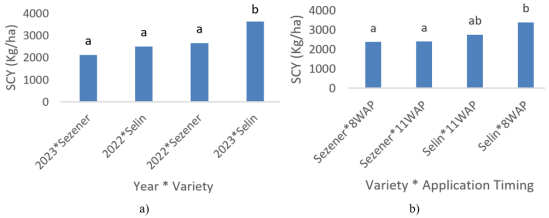
According to the results (Table 3), the mean comparison of the year × variety interaction revealed that the Selin variety in 2023 produced the highest seed cotton yield (3623 kg/ha), which was 2118 kg/ha greater than the yield of the Sezener variety in 2022 (Figure 3a). In contrast, the application timing × variety interaction indicated that the lowest yield (2375 kg/ha) was recorded for the Sezener variety when MC was applied at 8 WAP (Figure 3b).
When analyzed independently, the Selin variety exhibited the highest mean seed cotton yield (3067.11 kg/ha), which was 25.01% higher than that of the Sezener variety (2385.19 kg/ha) (Table 3). Among the Mepiquat chloride (MC) levels, the split application of 400 + 400 cc. ha-1 produced the highest yield (2822.33 kg/ha), marginally surpassing the 800 cc. ha-1 application (2822.13 kg/ha) (Table 3). In contrast, the 400 cc. ha-1 treatment reduced seed cotton yield by 8.10% compared to the control (Table 3).
Figure 3. Illustrates the interaction of year and variety (a) and variety and application time (b) on SCY. Different letters indicate significant difference at p < 0.05.
3.2.2. Boll Number per Plant
Mean comparisons for boll number revealed that the varieties were grouped into two statistically distinct categories (Table 2). The Selin variety produced the highest number of bolls per plant, while the Sezener variety had the lowest (Table 3). In the 2023 growing year, the Selin variety reached a maximum of 10.15 bolls/plant when MC was applied at 8 WAP (Table 4).
Among the MC levels, the 800 cc. ha-1 foliar application resulted in the highest boll number (9.33 bolls/plant), although it was not significantly different from the 400 + 400 cc. ha-1 split application, which produced 9.06 bolls/plant. Remarkably, the 400 cc. ha-1 treatment reduced boll number by 6.81% relative to the control (Table 3).
Table 4. Interaction of year, variety and application timing on boll number, spinning consistency index, fiber length and uniformity index.

Treatments

BN

SCI

UHML

UI

2022

Selin

8 WAP

7.33a

138.10ab

29.70c

83.33a

11 WAP

10.00c

141.50ab

29.75c

83.55ab

Sezener

8 WAP

8.17b

145.00ab

30.33d

83.85ab

11 WAP

7.6ab

134.20a

29.47c

83.21a

2023

Selin

8 WAP

10.15c

141.20ab

28.35b

84.83c

11 WAP

9.42c

136.70ab

27.75a

84.17bc

Sezener

8 WAP

7.3a

144.10ab

29.52c

84.81c

11 WAP

9.24c

147.00b

29.92cd

85.62d

Different superscript letters (a, b, c, d) in each column indicate significant difference at p < 0.05. WAP Weeks After Planting, BN Boll Number, SCI Spinning Consistency Index, UHML Upper Half Mean Length, UI Uniformity Index
3.2.3. Individual Fiber Weight
As revealed in Table 3, the Sezener variety recorded the highest individual fiber weight (10.02 µg) compared to the other variety. Notably, in 2023, this variety produced 41.68% higher than that of the Selin variety in 2022, which had the lowest value (7.89 µg) (Figure 6c). Year-wise comparisons indicated a significant increase in individual fiber weight in 2023 (11.59 µg) compared to 2022 (7.98 µg) (Table 3). Furthermore, the Sezener variety in 2023 recorded the highest individual fiber weight (12.42 µg) when treated with 400 cc. ha-1 of MC (Table 5). This value represented a 48.11% and 50.56% increase relative to the control × Selin (7.71 g) and 800 cc. ha-1 × Selin (7.47 µg) treatments in 2023, respectively (Table 5).
Table 5. Interaction of year, variety and concentration on individual fiber weight, fiber length and micronaire.

Treatments

IFW

UHML

Mic

2022

Selin

Control

7.71a

29.88e

3.08a

400

8.05a

30.19e

3.19a

400+400

8.32a

29.82de

3.32a

800

7.47a

29.02bcd

3.12a

Sezener

Control

8.16a

29.62cde

3.31a

400

8.22a

29.86e

3.29a

400+400

7.85a

30.41e

3.09a

800

8.04a

29.71cde

3.24a

2023

Selin

Control

11.45bc

28.31ab

4.77c

400

11.09b

28.07a

4.68bc

400+400

11.08b

28.05a

4.68bc

800

11.26bc

27.78a

4.80c

Sezener

Control

11.27bc

29.96e

400

12.42c

30.08e

4.83c

400+400

12.04bc

28.92bc

4.89c

800

12.13bc

29.92e

4.74bc

Different superscript letters (a, b, c, d, e) in each column indicate significant difference at p < 0.05. IFW Individual Fiber Weight, UHML Upper Half Mean Length, Mic Micronaire
3.2.4. Seed Index
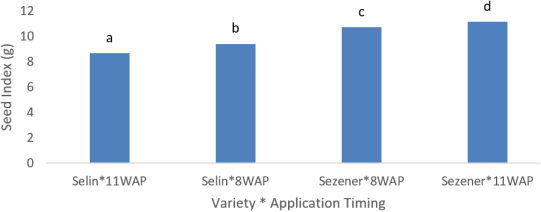
The variety × application timing interaction significantly influenced seed index, with the lowest value (8.66) observed for the Selin variety when MC was applied at 11 WAP (Figure 4). Across both cropping seasons, the Sezener variety exhibited a significantly higher mean seed index (10.91) compared to Selin variety (9.03) under MC application (P<0.05; Table 3, Figure 4).
No significant main effects were found for year, concentration, or application timing individually on seed index (Table 2). However, when analyzed by year, higher seed index values were observed under MC treatments in 2022 compared to 2023, with the maximum value (10.02) representing a modest 1% increase over 2023 (Table 3).
Regarding MC levels, the control (0 cc. ha-1) resulted in the lowest seed index (9.79), while the highest values (10.06) were observed under both 400 cc. ha-1 and 400 + 400 cc. ha-1 application rates. In terms of application timing, 8 WAP yielded a slightly higher seed index (10.04) compared to 11 WAP (9.90) (Table 3).
Figure 4. Illustrates the interaction effects of variety and application time on seed index (SI), with different letters indicating significant differences at P<0.05.
3.3. Fiber Qualitative Properties
3.3.1. Moisture Content
Analysis of variance showed that year had a significant effect on fiber moisture content (P≤0.01; Table 6). Mean comparisons indicated that the fiber moisture content in the second year was higher than in the first year. Specifically, the moisture content was 8.94% in 2023, representing a 6.23% increase compared with 2022 (Table 7).
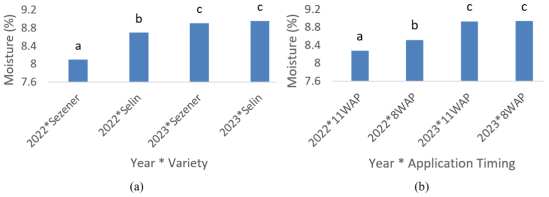
Varieties also significantly influenced fiber moisture content (P<0.05; Table 6). Across varieties, Selin exhibited higher moisture content (8.83%) than Sezener (8.51%) under MC treatment (Table 7). Furthermore, the year × variety interaction was significant (P<0.05; Table 6); the highest moisture content (8.97%) was recorded for Selin in 2023, which was 10.03% greater than that of Sezener in 2022 (Figure 5a).
Application timing significantly affected fiber moisture content (P<0.01; Table 6). The lowest moisture content (8.61%) was observed when MC was applied at 11 WAP (Table 7). The year × application timing interaction was also significant (P<0.05; Table 6). The 8 WAP treatment recorded the highest moisture content values (8.95% in 2023), whereas other timings showed relatively lower values (Figure 5b).
In contrast, moisture content did not differ significantly (P>0.05; Table 6) among MC application rates across both varieties. Nevertheless, the control (0 cc. ha-1) treatment recorded the highest mean moisture content (8.73%) (Table 6).
Figure 5. Illustrates the interaction effects on moisture, where (a) shows the interaction between year and variety, and (b) depicts the interaction between year and application time, with different letters indicating significant differences at P<0.05.
3.3.2. Spinning Consistency Index (SCI)
The analysis of variance revealed a significant (P<0.01; Table 6) three-way interaction among year × application timing × variety for the Spinning Consistency Index (SCI). Under varying MC application rates, the Sezener variety exhibited a significantly higher SCI (147.00) in 2023 when MC was applied at 11 WAP, whereas the lowest SCI (134.20) for this variety was recorded in 2022 (Table 4). Conversely, in the Selin variety, the SCI was slightly higher in 2022 (141.50) when MC was applied at 11 WAP than in 2023 (141.20) when MC was applied at 8 WAP (Table 4).
No significant main effects of year, variety, MC concentration, or application timing were detected when considered individually (Table 6). However, when the data were analyzed separately by year, higher SCI values were observed under Mepiquat chloride (MC) treatments in 2023 compared to 2022, with the maximum mean SCI (142.24) representing a modest 1.79% increase relative to 2022 (Table 7). Across MC levels, the control treatment (0 cc. ha-1) produced the highest SCI (142.27), whereas the lowest value (137.97) was recorded under the 800 cc. ha-1 rate. Regarding application timing, 8 WAP resulted in a slightly higher SCI (142.09) than 11 WAP (139.86) (Table 7).
Table 6. Variance analysis of some fiber qualitative properties of different cotton varieties influenced by application timing and MC concentrations in Mediterranean region (2022–2023).

S.O.V

df

Means Square

Mst

SCI

SF

Elg

UHML

MIC

Str

UI

Years (Y)

1

6.96**

154.38ns

35.79**

0.30*

20.60**

55.86**

384.99**

45.22**

Rep (R)

2

1.12

91.03

0.72

0.04

0.35

0.60

4.23

0.39

Varieties (V)

1

2.50*

247.77ns

0.77ns

0.35*

20.39**

0.01ns

0.78ns

3.92*

Y × V

1

1.79**

274.15ns

0ns

0.28ns

13.41**

0.02ns

3.73ns

2.35*

App. T (T)

1

0.36**

119.02ns

0.09ns

0.00ns

1.54ns

0.02ns

3.02ns

0.11ns

Y × T

1

0.31*

49.75ns

0.04ns

0.04ns

0.56ns

0.27*

1.00ns

0.48ns

V × T

1

0.02ns

66.85ns

1.10ns

0.20ns

0.01ns

0.07ns

12.43*

0.54ns

CONCs (C)

3

0.05ns

97.61ns

0.36ns

0.13ns

0.88ns

0.05ns

1.48ns

0.59ns

Y × C

3

0.06ns

200.92ns

0.71ns

0.05ns

1.53*

0.04ns

3.70ns

1.40ns

V × C

3

0.04ns

136.66ns

0.22ns

0.08ns

0.68ns

0.03ns

4.12ns

2.10*

T × C

3

0.07ns

103.04ns

0.32ns

0.03ns

0.19ns

0.03ns

4.86ns

1.90ns

Y × V × T

1

0.02ns

703.56**

1.59ns

0.07ns

5.53**

0.06ns

2.24ns

8.15**

Y × V × C

3

0.08ns

64.03ns

0.26ns

0.01ns

1.189*

0.26**

1.45ns

0.64ns

Y × T × C

3

0.02ns

54.97ns

0.29ns

0.23*

0.49ns

0.11ns

2.93ns

0.06ns

V × T × C

3

0.01ns

168.18ns

0.96ns

0.02ns

0.81ns

0.07ns

1.04ns

3.17**

Y × V × T × C

3

0.03ns

9.63ns

0.73ns

0.06ns

0.13ns

0.01ns

1.54ns

0.83ns

Error

0.23

9.31

0.67

0.28

0.65

0.25

1.75

0.86

CV (%)

2.6

6.6

8.1

5.0

2.20

6.30

5.70

1.00

ns, * and ** no significant, significant in 5 and 1% level. CONCs Concentrations, T Application timing, MST Moisture, SCI Spinning Consistency Index, SF Short Fibers, Elg Elongation, UHML Upper Half Mean Length, MIC Micronaire, Str Strength, UI Uniformity Index, CV Coefficient of variation, S.O.V. Sources of variations
3.3.3. Short Fiber Content
Analysis of variance revealed that the year had a significant effect on short fiber content (P≤0.01; Table 6). Mean comparisons showed that short fiber content was higher in 2022 (8.85%) than in 2023, reflecting a 14.81% decrease in the second year (Table 7).
No significant main effects of variety, MC concentration, or application timing, nor their interactions, were perceived when analyzed collectively (Table 6). However, within varieties, MC application resulted in higher short fiber content in Selin (8.33%) than in Sezener (8.15%) (Table 7). Across MC application doses, the 800 cc ha-1 treatment produced the highest short fiber content (8.40%), while the lowest value (8.10%) was recorded under the split 400 + 400 cc ha-1 rate (Table 7). MC applied at 11 WAP resulted in slightly higher short fiber content (8.27%) than at 8 WAP (8.21%) (Table 7).
Table 7. Effects of Mepiquat chloride concentrations and application timings on fiber qualitative properties of cotton varieties in the Mediterranean Region (2022–2023).

Treatments

Levels

Mst

SCI

SF

Elg

UHML

Mic

Str

UI

Years

2022

8.4a

139.71

8.85b

5.44a

29.81b

3.21a

28.68a

83.48a

2023

8.94b

142.24

7.63a

5.55b

28.89a

4.73b

32.69b

84.86b

LSD0.05

0.1

3.87

0.28

0.11

0.27

0.10

0.71

0.35

Varieties

Selin

8.83b

139.37

8.33

5.56b

28.89a

3.96

30.78

83.97a

Sezener

8.51a

142.58

8.15

5.44a

29.81b

3.98

30.60

84.37b

LSD0.05

0.17

6.44

0.4

0.11

0.27

0.10

0.71

0.35

App. T

8 WAP

8.73b

142.09

8.21

5.50

29.48

3.95

30.86

84.20

11 WAP

8.61a

139.86

8.27

5.49

29.22

3.98

30.51

84.14

LSD0.05

0.07

3.83

0.4

0.11

0.27

0.10

0.71

0.35

CONCs

Control

8.73

142.27

8.22

5.56

29.44

3.90

30.98

84.10

400

8.69

141.94

8.24

5.52

29.55

4.00

30.57

84.32

400 + 400

8.64

141.73

8.1

5.51

29.30

4.00

30.79

84.28

800

8.63

137.97

8.4

5.39

29.11

3.97

30.41

83.98

LSD0.05

0.11

5.41

0.37

0.16

0.38

0.14

1.01

0.50

Different superscript letters (a, b) in each column indicate significant difference at p < 0.05. CONCs Concentrations, APP.T Application timing, MST Moisture, SCI Spinning Consistency Index, SF Short Fibers, Elg Elongation, UHML Upper Half Mean Length, MIC Micronaire, Str Strength, UI Uniformity Index
3.3.4. Fiber Elongation
Analysis of variance indicated that the year had a significant effect on fiber elongation (P<0.05; Table 6). Mean comparison revealed that fiber elongation was higher in 2023 (5.55%) than in 2022, corresponding to a 2% reduction in the first year (Table 7). Varietal differences were also significant (P<0.05; Table 6), with Selin exhibiting greater fiber elongation (5.56%) than Sezener (5.44%) under MC treatment (Table 7). Moreover, a significant three-way interaction among year, application timing, and concentration was detected (P<0.05; Table 6). The highest fiber elongation (5.80%) occurred in the control treatment in 2023 when MC was applied at 8 WAP, whereas the lowest value (5.27%) was recorded in 2022 under the 800 cc. ha-1 treatment at the same timing (Table 8).
Table 8. Interaction of year, application timing and concentration on fiber elongation.

Fiber Elongation

Treatments

Control

400

400+400

800

2022

8 WAP

5.37a

5.50ab

5.55ab

5.27a

11 WAP

5.62ab

5.55ab

5.35a

5.32a

2023

8 WAP

5.80b

5.58ab

5.51ab

5.42ab

11 WAP

5.46ab

5.44ab

5.64ab

5.56ab

Different superscript letters (a, b,) in each column indicate significant difference at P<0.05. WAP Weeks After Planting
3.3.5. Fiber Length
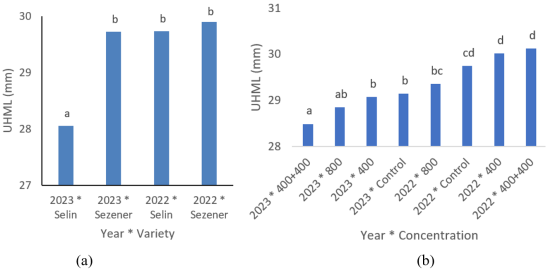
Analysis of variance exhibited a significant effect of year on fiber length (P<0.01; Table 6). Mean comparison indicated that the longest fibers (29.81 mm) were recorded in 2022, representing a 3.13% reduction in 2023 (Table 7). Varietal differences were significant (P<0.01; Table 6), with Sezener producing longer fibers (29.81 mm) than Selin (28.89 mm) under MC treatment (Table 7). A significant year × variety interaction was detected (P<0.01; Table 6); Sezener in 2022 unveiled the longest fibers (29.90 mm), which were 6.30% longer than those of Selin in 2023 (Figure 6a).
A significant year × concentration interaction was also observed (P<0.05; Table 6). The longest fibers (30.12 mm) occurred under the 400+400 cc. ha-1 treatment in 2022, while the shortest fibers (28.49 mm) were recorded under the same treatment in 2023 (Figure 6b). Furthermore, a significant three-way interaction (year × application timing × variety) was identified (P<0.01; Table 6). Sezener produced the longest fibers (30.33 mm) in 2022 when MC was applied at 8 WAP, whereas the shortest fibers (27.75 mm) were recorded for Selin in 2022 at 11 WAP (Table 4). Additionally, the year × variety × concentration interaction was significant (P<0.05; Table 6), with Sezener treated with 400 + 400 cc. ha-1 MC in 2022 exhibiting the longest fibers (30.41 mm), representing an 8.69% increase compared with the 800 cc. ha-1 × Selin treatment (27.78 mm) in 2023 (Table 5).
Figure 6. Illustrates the interaction effects on fiber quality traits, where (a) shows the interaction between variety and year and the interaction between year and concentration on fiber length (UHML) with different letters indicating significant differences at P<0.05.
3.3.6. Fiber Uniformity
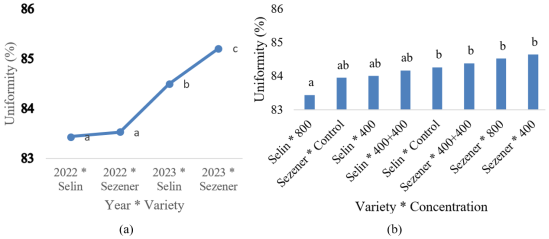
Analysis of variance revealed that the year had a significant effect on fiber uniformity (P<0.01; Table 6). Mean comparison exhibited that fiber uniformity was higher in 2023 (84.86%) than in 2022 (83.48%), representing a 1.64% increase in the second year (Table 7). Varietal differences were also significant (p < 0.05; Table 6), with Sezener recording higher fiber uniformity (84.37%) than Selin (83.97%) under MC treatment (Table 7).
A significant year × variety interaction was observed (P<0.05; Table 6); Sezener in 2023 recorded the highest fiber uniformity (85.21%), 2.10% higher than Selin in 2022 (Figure 7a). The variety × concentration interaction was also significant (P<0.05; Table 7), with Sezener treated with 400 cc. ha-1 showing the highest fiber uniformity (84.64%), while Selin treated with 800 cc. ha-1 exhibiting the lowest (83.44%) (Figure 7b).
Figure 7. Illustrates the interaction effects on fiber quality traits, where (a) shows the interaction between year x variety and the interaction between variety x concentration on fiber uniformity with different letters indicating significant differences at p < 0.05.
Furthermore, a significant three-way interaction among year, application timing, and variety was detected (P<0.01; Table 6). Under varying MC application rates, Sezener attained the highest fiber uniformity (85.62%) in 2023 when MC was applied at 11 WAP, while the lowest uniformity (83.21%) was recorded for the same variety in 2022 at the same timing (Table 4). Additionally, the variety × application timing × concentration interaction was significant (P<0.01; Table 6). The Sezener treated with 400 cc. ha-1 at 11 WAP unveiled the highest fiber uniformity (85.09%), representing a 2.58% increase compared with the Selin × 800 cc. ha-1 treatment (82.92%) at the 8 WAP (Table 9).
Table 9. Interaction of variety, application timing and concentration on uniformity index.

Uniformity index

Treatments

Control

400

400+400

800

Selin

8 WAP

84.93de

83.86abcd

84.59bcde

82.92a

11 WAP

83.58ab

84.14bcde

83.76abcd

83.96abcde

Sezener

8 WAP

83.72abc

84.18bcde

84.58bcde

84.84cde

11 WAP

84.18bcde

85.09e

84.18bcde

84.20bcde

3.3.7. Fiber Strength
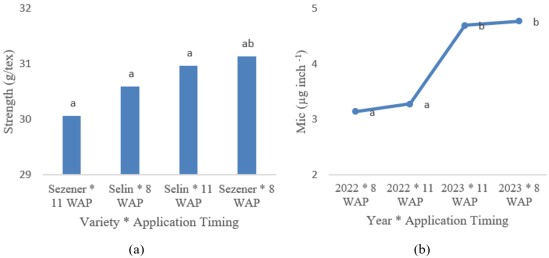
Analysis of variance indicated that the year had a significant effect on fiber strength (P<0.01; Table 6). Mean comparison exhibited that fiber strength was higher in 2023 (32.69 g tex-1) than in 2022 (28.68 g tex-1), representing a 13.07% increase in the second year (Table 7). A significant two-way interaction between variety and application timing was also perceived (P<0.05; Table 6). The Sezener variety exhibited the highest fiber strength (31.13 g tex-1) when MC was applied 8 WAP, while the lowest strength (30.06 g tex-1) was observed for the same variety when MC was applied at 11 WAP (Figure 8a).
Although differences among MC concentrations were not statistically significant (P>0.05; Table 6), mean comparisons unveiled notable trends. The control treatment (0 cc. ha-1) resulted in the highest fiber strength (30.98 g tex-1), followed by 400 + 400 cc. ha-1 (30.79 g tex-1), 400 cc. ha-1 (30.57 g tex-1), and 800 cc. ha-1 (30.41 g tex-1) (Table 7).
3.3.8. Fiber Micronaire
Analysis of variance showed that the year had a significant effect on fiber micronaire (P<0.01; Table 6). In 2023, varieties supplied with Mepiquat chloride exhibited significantly higher micronaire values (4.73 µg inch-1) than in 2022 (3.21 µg inch-1) (Table 7). A significant year × application timing interaction was also observed (P<0.05; Table 6). The highest micronaire (4.77 µg inch-1) was recorded under the 8 WAP treatment in 2023, whereas other timings resulted in comparatively lower values (Figure 8b).
Moreover, a significant three-way interaction among year, variety, and concentration was detected (P<0.01; Table 6). The Sezener variety in 2023 revealed the highest micronaire (4.89 µg inch-1) when treated with 400 + 400 cc. ha-1 of MC (Table 5), representing a 45.59% increase compared with the control × Selin treatment (3.08 µg inch-1) in 2022.
Figure 8. Illustrates the interaction effects on fiber quality traits, where (a) shows the interaction between variety and application time on fiber strength, and (b) the interaction between year and application time on micronaire with different letters indicating significant differences at P<0.05.
4. Discussion
The present study demonstrates that genotype, environment, and MC application interactively regulate cotton growth dynamics, yield formation, and fiber quality attributes. The significant year × variety interaction for plant height and leaf area underscores the strong genotype × environment (G × E) influence on vegetative development, consistent with earlier studies showing that climatic variability and cultivar-specific growth habits shape cotton responses to growth regulators . The reduction in plant height and leaf expansion with 400 cc ha-1 MC concentration or earlier application aligns with its known anti-gibberellin mode of action, which restricts vegetative vigor and redirects assimilates toward reproductive sinks .
Environmental conditions exerted a significant influence on monopodial branching, with water deficit conditions reducing branch formation and subsequently influencing fiber yield and quality. This aligns with previous observations that abiotic stress limits vegetative branching and reproductive potential . Although varietal differences in branch number were not significant across years, the results emphasize that branch development depends on a complex interplay of genotype, environment, growth stage, and growth regulator application. Optimizing these factors is crucial, as monopodial branches contribute substantially to reproductive capacity and yield performance .
Early MC application enhanced monopodial branching and boll formation, demonstrating that precise timing is critical for maximizing sink strength at the onset of reproductive development . This physiological advantage was particularly evident in the Selin cultivar, which exhibited a superior source–sink balance and reproductive efficiency compared to Sezener. These findings corroborate previous reports highlighting cultivar-specific yield responses to MC and the necessity of genotype-targeted growth regulator strategies .
MC application variably influenced yield components such as seed index, seed cotton yield, and individual fiber weight. Enhanced yield, seed index and fiber weight in MC-treated plants likely resulted from improved physiological and biochemical activity, including increased carotenoid and chlorophyll content, higher stomatal conductance, and enhanced enzyme activities, all of which support efficient carbon assimilation, carbohydrate metabolism, and protein and sugar biosynthesis . Moreover, morphological adjustments—such as reduced canopy size, improved light penetration, increased monopodial branches, and a lower height-to-node ratio— further enhanced photoassimilate partitioning to reproductive structures, improving boll development and yield potential .
Moisture content, which strongly affects fiber quality traits, was affected by variety, seasonal conditions, and MC application timing. A notable reduction in moisture content with split or moderate MC doses applied at later stages advocates that delayed application may enhance secondary wall deposition and promote fiber maturation, consistent with . In contrast, the higher moisture content in untreated plants indicates a potential trade-off between growth regulation and fiber quality . The consistently lower moisture levels observed in the Sezener variety underscore inherent genotypic differences in fiber physiology, reflecting the role of intrinsic metabolic traits in fiber development . Moreover, the profound impact of climatic variability on short fiber content and moisture levels reinforces the complexity of genotype–environment interactions that collectively determine cotton fiber development and quality attributes . The detected reduction in short fiber content under optimized MC regimes further confirms that growth regulator management can modulate fiber structural properties beyond yield-related components .
Fiber elongation, crucial for yarn strength and spinning performance, was significantly higher in 2023 and in the Selin variety under MC treatment. Year-to-year variation is likely due to climatic influences on fiber cell wall elongation and secondary wall formation . The significant year × application timing × concentration interaction indicates that MC can modulate fiber elongation dynamics, likely by influencing assimilate partitioning during fiber development . Notably, the highest elongation was recorded in the untreated conditions, suggesting that suboptimal or excessive MC suppression can hinder fiber extensibility. Fiber length, vital for spinning efficiency, was consistently greater in Sezener, with significant effects of year and treatment interactions. Enhanced fiber length with split or moderate MC application suggests that balanced vegetative control supports optimal fiber elongation, whereas excessive doses or delayed applications may inhibit cell elongation .
Micronaire, a key determinant of fiber fineness and maturity, was higher in 2023, particularly in Sezener treated with moderate MC doses, reflecting thicker and more mature fibers . Environmental conditions, especially temperature during boll maturation, likely contributed to these differences . The significant three-way interaction among year, variety, and concentration demonstrates genotype-specific sensitivity to MC, where moderate doses promote secondary wall thickening, while excessive levels can dilute assimilate availability and reduce fiber maturity .
Fiber strength, determined by cell wall thickness, fiber length, and cellulose content, was significantly higher in 2023 and influenced by the variety × application timing interaction. Sezener achieved the highest strength when MC was applied at 8 WAP, suggesting that early growth regulation enhances cellulose deposition and fiber structural integrity. However, these results contrast with the findings reported by . Although MC concentration effects were not statistically significant, trends indicated that low or split applications promote fiber reinforcement without compromising plant vigor. Finally, fiber uniformity, which affects yarn evenness and quality, was highest in 2023 for Sezener, with significant interactions involving all studied factors (Table 9). Improved uniformity with moderate MC application (400 cc. ha-1 at 11 WAP) suggests that balanced growth control and synchronized boll development reduce variability in fiber maturity . Excessive or poorly timed MC applications, however, may disrupt developmental synchrony, resulting in uneven fiber formation. These findings reinforce the importance of aligning MC management with varietal characteristics and environmental conditions to optimize fiber uniformity and quality .
5. Conclusions
This study demonstrates that genotype, environmental conditions, and Mepiquat chloride (MC) management interact significantly to influence cotton growth dynamics, yield formation, and fiber quality. The results highlight that optimizing MC application particularly through split or moderate-dose treatments (e.g., 400 + 400 cc. ha-1) can effectively regulate vegetative growth, enhance yield components, and improve key fiber traits such as micronaire, strength, and uniformity. Early-to-mid reproductive stage applications (around 8 weeks after planting) are more effective in enhancing branching and boll development, whereas slightly later applications can improve fiber uniformity and micronaire. Genotypic differences were evident: Selin unveiling superior yield potential, while Sezener exhibited advantages in fiber quality attributes, signifying that cultivar selection should align with production goals to enable targeted management strategies. Seasonal variability further emphasized the importance of aligning MC strategies with environmental conditions to maximize agronomic performance; therefore, application strategies should be tailored to prevailing climatic conditions and soil fertility status. Collectively, these findings provide a scientific basis for integrating growth regulator management with genotype selection to achieve balanced growth, improved yield, and superior fiber quality under Mediterranean production systems. Hence, further studies should focus on integrating physiological, molecular, and agronomic approaches to refine MC use efficiency across diverse genotypes and environments, ultimately facilitating the development of decision-support tools to promote sustainable cotton production and meet fiber industry requirements.
Abbreviations

cc

Cubic Centimeter

g

Gram

MC

Mepiquat Chloride

PH

Plant Height

pH

Potential of Hydrogen

S.O.V

Sources of Variation

SCY

Seed Cotton Yield

TSMS

Turkish State Meteorological Service

WAP

Weeks After Planting

μg

Microgram

Acknowledgments
The authors gratefully acknowledge the support provided by Ondokuz Mayıs University. They also sincerely thank the Center Manager of TARI Hombolo for agreeing to cover the article processing charges (APC). Additional support was provided by the Eastern Mediterranean Agricultural Research Institute Directorate through the provision of experimental farmland and HVI facilities for fiber quality analysis. The authors further express their sincere appreciation to Mr. Mustafa Demir for his valuable assistance during the experimental work.
Author Contributions
Mashenene Malima: Conceptualization, Investigation, Methodology, Resources, Validation, Visualization, Writing – original draft, Writing – review & editing
Orhan Kurt: Conceptualization, Funding Acquisition, Methodology, Project Administration, Resources, Supervision, Validation, Visualization, Writing – Review & Editing
Sikitu Jonathan Kazungu: Data curation, Formal Analysis, Software
Muhammet Safa Hacikamiloglu: Data curation, Formal Analysis, Validation, Visualization
Thereza Fabiani Deus: Formal Analysis, Writing – original draft, Writing – review & editing
Funding
This work was funded by Ondokuz Mayıs University through the Scientific Research Projects (BAP) grant (PYO.ZRT.1904.23.017), while the article processing charge (APC) was supported by the Tanzania Agricultural Research Institute (TARI), Hombolo Centre.
Data Availability Statement
The data is available from the corresponding author upon reasonable request.
Conflicts of Interest
The authors declare no conflicts of interest.
References
[1] Mangi N, Iqbal MS, Shuli F, Iqbal MT, Alharthi B, Jatoi GH, Sarfraz Z, Ma Q, Sun X. Empowering Cotton Breeding Programs Through the Strategic Exploration and Exploitation of Phenotypic Diversity of Genetic Resources Under Climate Change Conditions. Plant Stress 2024; 13: 100548.
[2] Thavkar S, Thube S, Panchbhai P, Lavhe N, Pillai T, Shah V, Deshmukh V, Pandian TR, Fand B, Tenguri P, Nikoshe A, Priyank M, Behere G, Prasad Y. Evaluation of Bio-efficacy of Metarhizium Anisopliae Against the Pink Bollworm Pectinophora Gossypiella (Saunders), with Insights into its Colonization Potential and Insecticide Compatibility. Journal of Cotton Research 2025; 8: 8.
[3] Çınar VM, Balcı Ş, Şimşek MK, Ünay A. Breeding of Brown Cotton for Spinnable Yarn in Intraspecific and Interspecific Hybrids (G. Hirsutum L. and G. Barbadense L.). Ind Crops Prod 2023; 202: 116995.
[4] Liu S, Zuo D, Cheng H, He M, Wang Q, Lv L, Zhang Y, Ashraf J, Liu J, Song G. Cotton Pedigree Genome Reveals Restriction of Cultivar-Driven Strategy in Cotton Breeding. Genome Biol 2023; 24: 282.
[5] Zhang Y, Yang Y, Lu X, Wang A, Xue C, Zhao M, Zhang J. The Effects and Interrelationships of Intercropping on Cotton Verticillium Wilt and Soil Microbial Communities. BMC Microbiol 2023; 23: 41.
[6] Keller C, Joshi S, Joshi T, Goldmann E, Riar A. Challenges for Crop Diversification in Cotton-Based Farming Systems in India: A Comprehensive Gap Analysis Between Practices and Policies. Frontiers in Agronomy 2024; 6.
[7] Damalas CA, Koutroubas SD. Current Status of Herbicide Resistance in Global Cotton Production: Trends and Perspectives. Crop Protection 2025; 197: 107320.
[8] Zhu Y, Zhao M, Li T, Wang L, Liao C, Liu D, Zhang H, Zhao Y, Liu L, Ge X, Li B. Interactions Between Verticillium Dahliae and Cotton: Pathogenic Mechanism and Cotton Resistance Mechanism to Verticillium Wilt. Front Plant Sci 2023; 14.
[9] Tlatlaa JS, Tryphone GM, Nassary EK. Unexplored Agronomic, Socioeconomic and Policy Domains for Sustainable Cotton Production on Small Landholdings: A Systematic Review. Frontiers in Agronomy 2023; 5.
[10] Zafar MM, Manan A, Razzaq A, Zulfqar M, Saeed A, Kashif M, Khan AI, Sarfraz Z, Mo H, Iqbal MS, Shakeel A, Ren M. Exploiting Agronomic and Biochemical Traits to Develop Heat Resilient Cotton Cultivars under Climate Change Scenarios. Agronomy 2021; 11: 1885.
[11] Zafar MM, Jia X, Shakeel A, Sarfraz Z, Manan A, Imran A, Mo H, Ali A, Youlu Y, Razzaq A, Iqbal MS, Ren M. Unraveling Heat Tolerance in Upland Cotton (Gossypium hirsutum L.) Using Univariate and Multivariate Analysis. Front Plant Sci 2022; 12.
[12] Arekhi E, Ghasemi Bezdi K, Ajam Norozei H, Faghani E. The Effect of Growth Regulators on Biochemical Properties, Yield, and Fiber Quality of Different Cultivars of cotton (Gossypium Hirsutum) Under Different Irrigation Intervals. J Plant Growth Regul 2023; 42: 5574–86.
[13] Ullah A, Shakeel A, Ahmed HGM-D, Naeem M, Ali M, Shah AN, Wang L, Jaremko M, Abdelsalam NR, Ghareeb RY, Hasan ME. Genetic Basis and Principal Component Analysis in Cotton (Gossypium Hirsutum L.) Grown Under Water Deficit Condition. Front Plant Sci 2022; 13.
[14] Amissah S, Baidoo M, Agyei BK, Ankomah G, Black RA, Perry CD, Hollifield S, Kusi NY, Harris GH, Sintim HY. Early and Late Season Nutrient Stress Conditions: Impact on Cotton Productivity and Quality. Agronomy 2022; 13: 64.
[15] Çınar VM, Balcı Ş, Ünay A. Yield and Fiber Quality Characteristics of Mutation-Based IMI Tolerant Cotton (Gossypium hirsutum L.) Lines. Adnan Menderes Üniversitesi Ziraat Fakültesi Dergisi 2024; 21: 9–15.
[16] Zafar MM, Chattha WS, Khan AI, Zafar S, Subhan M, Saleem H, Ali A, Ijaz A, Anwar Z, Qiao F, Shakeel A, Seleiman MF, Wasonga DO, Parvaiz A, Razzaq A, Xuefei J. Drought and Heat Stress on Cotton Genotypes Suggested Agro-Physiological and Biochemical Features for Climate Resilience. Front Plant Sci 2023; 14.
[17] Khan MA, Anwar S, Abbas M, Aneeq M, de Jong F, Ayaz M, Wei Y, Zhang R. Impacts of Climate Change on Cotton Production and Advancements in Genomic Approaches for Stress Resilience Enhancement. Journal of Cotton Research 2025; 8: 17.
[18] Zhang J, Wang H, Feng D, Cao C, Zheng C, Dang H, Li K, Gao Y, Sun C. Evaluating the Impacts of Long-Term Saline Water Irrigation on Soil Salinity and Cotton Yield Under Plastic Film Mulching: A 15-Year Field Study. Agric Water Manag 2024; 293: 108703.
[19] Çelik S. Assessing Drought Tolerance in a Large Number of Upland Cotton Plants (Gossypium hirsutum L.) under Different Irrigation Regimes at the Seedling Stage 2023; 13: 2067.
[20] Beegum S, Reddy V, Reddy KR. Development of a Cotton Fiber Quality Simulation Module and its Incorporation into Cotton Crop Growth and Development Model: GOSSYM. Comput Electron Agric 2023; 212: 108080.
[21] Sreedasyam A, Lovell JT, Mamidi S, Khanal S, Jenkins JW, Plott C, Bryan KB, Li Z, Shu S, Carlson J, Goodstein D, De Santiago L, Kirkbride RC, Calleja S, Campbell T, Koebernick JC, Dever JK, Scheffler JA, Pauli D, Jenkins JN, McCarty JC, Williams M, Boston L, Webber J, Udall JA, Chen ZJ, Bourland F, Stiller WN, Saski CA, Grimwood J, Chee PW, Jones DC, Schmutz J. Genome Resources for Three Modern Cotton Lines Guide Future Breeding Efforts. Nat Plants 2024; 10: 1039–51.
[22] Saini DK, Impa SM, McCallister D, Patil GB, Abidi N, Ritchie G, Jaconis SY, Jagadish KS V. High Day and Night Temperatures Impact on Cotton Yield and Quality—Current Status and Future Research Direction. Journal of Cotton Research 2023; 6: 16.
[23] Sharma A, Deepa R, Sankar S, Pryor M, Stewart B, Johnson E, Anandhi A. Use of Growing Degree Indicator for Developing Adaptive Responses: A Case Study of Cotton in Florida. Ecol Indic 2021; 124: 107383.
[24] Zhang M, Cao H, Xi J, Zeng J, Huang J, Li B, Song S, Zhao J, Pei Y. Auxin Directly Upregulates GhRAC13 Expression to Promote the Onset of Secondary Cell Wall Deposition in Cotton Fibers. Front Plant Sci 2020; 11.
[25] Al-Khayri JM, Arif M, Kareem SHS, Anwar A, Dehghanisanij H, Emami S, Yasmeen A, Aftab K, Negm M. Exogenous Application of Bio-Stimulants and Growth Retardants Improve Nutrient Absorption and Fiber Quality in Upland Cotton. Journal of Cotton Research 2024; 7: 15.
[26] Chalise DP, Snider JL, Hand LC, Roberts P, Vellidis G, Ermanis A, Collins GD, Lacerda LN, Cohen Y, Pokhrel A, Parkash V, Lee JM. Cultivar, Irrigation Management, and Mepiquat Chloride Strategy: Effects on Cotton Growth, Maturity, Yield, and Fiber Quality. Field Crops Res 2022; 286: 108633.
[27] Liang F, Yang C, Sui L, Xu S, Yao H, Zhang W. Flumetralin and Dimethyl Piperidinium Chloride Alter Light Distribution in Cotton Canopies by Optimizing The Spatial Configuration of Leaves and Bolls. J Integr Agric 2020; 19: 1777–88.
[28] Zhang M, Zhang X, Zhang L, Zeng L, Liu Y, Wang X, He P, Li S, Liang G, Zhou W, Ai C. The Stronger Impact of Inorganic Nitrogen Fertilization on Soil Bacterial Community Than Organic Fertilization in Short-Term Condition. Geoderma 2021; 382: 114752.
[29] Meng L, Yu K, Wei Z, Li K, Dai J, Li F, Qi H, Sun L, Zhang L, Dong H, Lu Z, Xu D, Zhang M, Du M, Tian X, Li Z. High Dosage of Mepiquat Chloride Delays Defoliation of Harvest Aids in Cotton. Ind Crops Prod 2023; 202: 116998.
[30] Shi F, Li N, Khan A, Lin H, Tian Y, Shi X, Li J, Tian L, Luo H. DPC Can Inhibit Cotton Apical Dominance and Increase Seed Yield by Affecting Apical Part Structure and Hormone Content. Field Crops Res 2022; 282: 108509.
[31] Zhao W, Du M, Xu D, Lu H, Tian X, Li Z. Interactions of Single Mepiquat Chloride Application at Different Growth Stages with Climate, Cultivar, and Plant Population for Cotton Yield. Crop Sci 2017; 57: 1713–24.
[32] Malima M, Kurt O, Hacıkamiloğlu MS. Response to Reduced Doses of Mepiquat Chloride on Yield and Quality Characteristics of Cotton (Gossypium hirsutum L.) in the Mediterranean Region of Türkiye. Akademik Ziraat Dergisi 2025; 14: 105–14.
[33] Wang Z, Li Y, Zhu Q, Tian L, Liu F, Zhang X, Sun J. Transcriptome Profiling Provides New Insights into the Molecular Mechanism Underlying the Sensitivity of Cotton Varieties to Mepiquat Chloride. Int J Mol Sci 2022; 23: 5043.
[34] EL Sabagh A, Islam MS, Hossain A, Iqbal MA, Mubeen M, Waleed M, Reginato M, Battaglia M, Ahmed S, Rehman A, Arif M, Athar H-U-R, Ratnasekera D, Danish S, Raza MA, Rajendran K, Mushtaq M, Skalicky M, Brestic M, Soufan W, Fahad S, Pandey S, Kamran M, Datta R, Abdelhamid MT. Phytohormones as Growth Regulators During Abiotic Stress Tolerance in Plants. Frontiers in Agronomy 2022; 4.
[35] Grundy PR, Yeates SJ, Bell KL. Cotton Production During the Tropical Monsoon Season. I – The Influence of Variable Radiation on Boll Loss, Compensation and Yield. Field Crops Res 2020; 254: 107790.
[36] Rosolem CA, Oosterhuis DM, Souza FS de. Cotton Response to Mepiquat Chloride and Temperature. Sci Agric 2013; 70: 82–7.
[37] Abbas H, Wahid MA, Sattar A, Tung SA, Saleem MF, Irshad S, Alkahtani J, Elshikh MS, Cheema M, Li Y. Foliar Application of Mepiquat Chloride and Nitrogen Improves Yield and Fiber Quality Traits of Cotton (Gossypium Hirsutum L.). PLoS One 2022; 17: e0268907.
[38] Lee JM, Snider JL, Roberts P, Hand LC, Culpepper AS, Pokhrel A, Chalise DP. The Effect of Pre-Drought Mepiquat Chloride Management on Cotton Sensitivity to Drought During Peak Water Demands. Field Crops Res 2023; 298: 108969.
[39] Hand LC, Snider JL, Roberts PM. Investigating The Rain‐Free Period of Mepiquat Chloride as Affected by Surfactant, Rate, and Interval Between Application and Simulated Rainfall. Crop, Forage & Turfgrass Management 2023; 9.
[40] Luo H, Zhang Z, Wu J, Wu Z, Wen T, Tang F. Effects of Mepiquat Chloride and Plant Population Density on Leaf Photosynthesis and Carbohydrate Metabolism in Upland Cotton. Journal of Cotton Research 2023; 6: 20.
[41] Reddy AR, Reddy KR, Hodges HF. Mepiquat chloride (PIX)-Induced Changes in Photosynthesis and Growth of Cotton. Plant Growth Regul 1996; 20: 179–83.
[42] Tung SA, Huang Y, Hafeez A, Ali S, Khan A, Souliyanonh B, Song X, Liu A, Yang G. Mepiquat Chloride Effects on Cotton Yield and Biomass Accumulation Under Late Sowing and High Density. Field Crops Res 2018; 215: 59–65.
[43] Kızılsımsek M, Günaydın T, Akbay F. Determination of Feed Quality Characteristics of Some Silage Maize (Zea Mays L.) Hybrids Cultivated in Eastern Mediterranean Conditions. Turkish Journal Of Field Crops 2024; 29: 46–53.
[44] Gee GW, Or D. 2.4 Particle‐Size Analysis. In: Dane Jacob H., Topp Clarke G., editors. Methods of Soil Analysis, Part 4: Physical Methods, 2002, p. 255–93.
[45] Mclean EO. Soil pH and Lime Requirement. In: A. L. Page, editor. Methods of Soil Analysis: Part 2 Chemical and Microbiological Properties. 2nd ed., 1982, p. 199–224.
[46] Nelson DW, Sommers LE. Total Carbon, Organic Carbon, and Organic Matter. In: D. L. Sparks, A. L. Page, P. A. Helmke, R. H. Loeppert, P. N. Soltanpour, M. A. Tabatabai, C. T. Johnston, M. E. Sumner, editors. Methods of Soil Analysis: Part 3 Chemical Methods, 1996, p. 961–1010.
[47] Olsen SR, Sommers LE. Phosphorus. In: Page A. L., editor. Methods of Soil Analysis: Part 2 Chemical and Microbiological Properties. 2nd ed., 1982, p. 403–30.
[48] Thomas GW. Exchangeable Cations. In: Page A. L., editor. Methods of Soil Analysis: Part 2 Chemical and Microbiological Properties. 2nd ed., 1982, p. 159–65.
[49] Anonymous. The State of the Türkiye’s Climate in 2022. Ankara: 2023.
[50] Anonymous. The State of the Türkiye’s Climate in 2023. Ankara: 2024.
[51] Dharani K, Ravichandran V, Anandakumar S, Sritharan N, Sakthivel N. Impact of Growth Retardant and Defoliant on Morpho-physiological Traits and Yield Improvement in Cotton. Int J Plant Soil Sci 2022: 635–44.
[52] Hu T, Liu Z, Jin D, Chen Y, Zhang X, Chen D. Effects of Growth Regulator and Planting Density on Cotton Yield and N, P, and K Accumulation in Direct-Seeded Cotton. Agronomy 2023; 13: 501.
[53] Priyadarshini M, Kumar GS, Nagabhushanam U, Reddy KPC. Effect of Different Doses and Scheduling Time of Plant Growth Regulators and Defoliants on Growth and Yield of Cotton (Gossypium hirsutum L.) under High Density Planting System. International Journal of Environment and Climate Change 2023; 13: 2252–60.
[54] Ayele AddissuG, Dever JK, Kelly CM, Sheehan M, Morgan V, Payton P. Responses of Upland Cotton (Gossypium hirsutum L.) Lines to Irrigated and Rainfed Conditions of Texas High Plains. Plants 2020; 9: 1598.
[55] Tlatlaa JS, Tryphone GM, Nassary EK. Effects of Sowing Dates and Phosphorus Levels on Cotton Growth and Yield: Soil Analysis and Implications. Front Sustain Food Syst 2023; 7.
[56] Altun D, Karademir E. Determination of Yield and Yield Criteria of Different Cotton Lines and Varieties. Adnan Menderes Üniversitesi Ziraat Fakültesi Dergisi 2024; 21: 37–44.
[57] Murtza K, Ishfaq M, Akbar N, Hussain S, Anjum SA, Bukhari NA, AlGarawi AM, Hatamleh AA. Effect of Mepiquat Chloride on Phenology, Yield and Quality of Cotton as a Function of Application Time Using Different Sowing Techniques. Agronomy 2022; 12: 1200.
[58] Singh K, Harinderpal S, Pankaj R, Kuldeep S, Sudhir KM. Manipulations of Source Sink Relationships Through Mepiquat Chloride for Enhancing Cotton Productivity and Monetary Returns in North West India. Journal of Cotton Research and Development 2017; 31: 62–8.
[59] Zhao W, Yan Q, Yang H, Yang X, Wang L, Chen B, Meng Y, Zhou Z. Effects of Mepiquat Chloride on Yield and Main Properties of Cottonseed Under Different Plant Densities. Journal of Cotton Research 2019; 2: 10.
[60] Malima M, Kurt O, Hacikamiloglu MS. Quantifying the Impact of Environmental Conditions on the Effectiveness of Mepiquat Chloride in Modulating Canopy Architecture, Yield, and Quality of Drought-Stressed Cotton (Gossypium Hirsutum L.). Journal of Current Opinion in Crop Science 2025; 6: 6–17.
[61] Wu Y, Tang C, Zhang Y, Du M, Yang M, Tian J, Zhang W. Synergistic Improvement of Cotton Yield and Fiber Quality in Heat-Deficient Regions: Selecting Varieties Sensitive to Mepiquat Chloride and Increasing Planting Density. Ind Crops Prod 2025; 235: 121781.
[62] Ahmad I, Guanglong Z, Zhou G, Younas MU, Yan X. Melatonin and Mepiquat Chloride Impact on Cotton Growth, Physiological, and Yield at Different Growth Stages. Ind Crops Prod 2025; 226: 120702.
[63] Abia Younas, Iram Sharif, Ghulam Sarwar, Amna Nazir, Jamshaid Ali Junaid, Muhammad Farooq, Jehanzeb Farooq. Impact of Plant Growth Regulators on Yield and Fiber Quality in Cotton (Gossypium hirsutum). Integrative Plant Biotechnology 2025; 3: 29–37.
[64] Beegum S, Hassan MA, Reddy KN, Reddy V, Reddy KR. Assessing Fiber Quality Variability Among Modern Upland Cotton Cultivars and Incorporating it into the GOSSYM-Based Fiber Quality Simulation Model. Journal of Cotton Research 2025; 8: 18.
[65] Jia Y, Yang B, Han Y, Wang G, Su T, Li X, Lei Y, Zhi X, Xiong S, Xin M, Li Y, Feng L. Enhanced Cotton Yield and Fiber Quality by Optimizing Irrigation Amount and Frequency in Arid Areas of Northwest China. Agronomy 2024; 14: 266.
[66] Darawsheh MK, Beslemes D, Kouneli V, Tigka E, Bilalis D, Roussis I, Karydogianni S, Mavroeidis A, Triantafyllidis V, Kosma C, Zotos A, Kakabouki I. Environmental and Regional Effects on Fiber Quality of Cotton Cultivated in Greece. Agronomy 2022; 12: 943.
[67] Tlatlaa JS, Tryphone GM, Kisetu Nassary E. Improving Cotton Fiber Quality Through Strategic Sowing: Implications for Phosphorus Management from Experiments in Chato District, Tanzania. Journal of Natural Fibers 2024; 21.
[68] Leal AJF, Piati GL, Leite RC, Zanella MS, Osorio CRWS, Lima SF. Nitrogen and Mepiquat Chloride Can Affect Fiber Quality and Cotton Yield. Revista Brasileira de Engenharia Agrícola e Ambiental 2020; 24: 238–43.
[69] Thapliyal D, Verma S, Sen P, Kumar R, Thakur A, Tiwari AK, Singh D, Verros GD, Arya RK. Natural Fibers Composites: Origin, Importance, Consumption Pattern, and Challenges. Journal of Composites Science 2023; 7: 506.
[70] Raphael JPA, Echer FR, Rosolem CA. Understanding Fiber Quality in Field-Grown Shaded Cotton: Nitrogen Fertilization Implications. Field Crops Res 2024; 317: 109543.
[71] Chen Y, Liu Z, Heng L, Leila IMT, Zhang X, Chen Y, Chen D. Effects of Plant Density and Mepiquat Chloride Application on Cotton Boll Setting in Wheat–Cotton Double Cropping System. J Integr Agric 2021; 20: 2372–81.
Cite This Article
  • APA Style

    Malima, M., Kurt, O., Kazungu, S. J., Hacikamiloglu, M. S., Deus, T. F. (2026). Effectiveness of Mepiquat Chloride Application Timing on Physiological, Agronomic, and Fiber Quality Traits of Cotton (Gossypium spp.) Varieties. International Journal of Applied Agricultural Sciences, 12(2), 54-73. https://doi.org/10.11648/j.ijaas.20261202.15

    Copy | Download

    ACS Style

    Malima, M.; Kurt, O.; Kazungu, S. J.; Hacikamiloglu, M. S.; Deus, T. F. Effectiveness of Mepiquat Chloride Application Timing on Physiological, Agronomic, and Fiber Quality Traits of Cotton (Gossypium spp.) Varieties. Int. J. Appl. Agric. Sci. 2026, 12(2), 54-73. doi: 10.11648/j.ijaas.20261202.15

    Copy | Download

    AMA Style

    Malima M, Kurt O, Kazungu SJ, Hacikamiloglu MS, Deus TF. Effectiveness of Mepiquat Chloride Application Timing on Physiological, Agronomic, and Fiber Quality Traits of Cotton (Gossypium spp.) Varieties. Int J Appl Agric Sci. 2026;12(2):54-73. doi: 10.11648/j.ijaas.20261202.15

    Copy | Download

  • @article{10.11648/j.ijaas.20261202.15,
      author = {Mashenene Malima and Orhan Kurt and Sikitu Jonathan Kazungu and Muhammet Safa Hacikamiloglu and Thereza Fabiani Deus},
      title = {Effectiveness of Mepiquat Chloride Application Timing on Physiological, Agronomic, and Fiber Quality Traits of Cotton (Gossypium spp.) Varieties},
      journal = {International Journal of Applied Agricultural Sciences},
      volume = {12},
      number = {2},
      pages = {54-73},
      doi = {10.11648/j.ijaas.20261202.15},
      url = {https://doi.org/10.11648/j.ijaas.20261202.15},
      eprint = {https://article.sciencepublishinggroup.com/pdf/10.11648.j.ijaas.20261202.15},
      abstract = {A two-year field study underscores the importance of integrating genotype selection with optimized Mepiquat Chloride (MC) management to enhance cotton performance under a split–split–plot design. Significant genotype × environment × management interactions were observed in cotton growth, yield, and fiber quality responses MC application. Plant height was significantly affected by year × variety interaction (p -1 enhanced leaf expansion. Monopodial branches were significantly greater in 2023 (9.59 plant-1), with early MC application favoring branch initiation. Seed cotton yield was peak in Selin (3623 kg ha-1), 25% greater than Sezener, with split application (400 + 400 cc. ha-1) yielding best results. Boll number and individual fiber weight were higher in Selin and Sezener, respectively, with the latter showing a 48% increase under 400 cc. ha-1. Seed index was significantly higher in Sezener, and fiber moisture increased in 2023 (8.94%). Fiber quality traits revealed pronounced year, genotype, and application timing effects: fiber length peaked in Sezener (30.33 mm), elongation reached 5.80%, and micronaire increased to 4.89 µg inch-1 under split MC application. Fiber strength increased by 13.07% in 2023, and while uniformity (85.62%) maximized with later application. Short fiber content decreased by 14.81% in 2023. These findings highlight that MC concentration, timing, and genotype interactions significantly modulate morphophysiological traits, yield components, and fiber quality, with split or moderate-dose applications enhancing productivity and fiber properties under Mediterranean conditions.},
     year = {2026}
    }
    

    Copy | Download

  • TY  - JOUR
    T1  - Effectiveness of Mepiquat Chloride Application Timing on Physiological, Agronomic, and Fiber Quality Traits of Cotton (Gossypium spp.) Varieties
    AU  - Mashenene Malima
    AU  - Orhan Kurt
    AU  - Sikitu Jonathan Kazungu
    AU  - Muhammet Safa Hacikamiloglu
    AU  - Thereza Fabiani Deus
    Y1  - 2026/04/24
    PY  - 2026
    N1  - https://doi.org/10.11648/j.ijaas.20261202.15
    DO  - 10.11648/j.ijaas.20261202.15
    T2  - International Journal of Applied Agricultural Sciences
    JF  - International Journal of Applied Agricultural Sciences
    JO  - International Journal of Applied Agricultural Sciences
    SP  - 54
    EP  - 73
    PB  - Science Publishing Group
    SN  - 2469-7885
    UR  - https://doi.org/10.11648/j.ijaas.20261202.15
    AB  - A two-year field study underscores the importance of integrating genotype selection with optimized Mepiquat Chloride (MC) management to enhance cotton performance under a split–split–plot design. Significant genotype × environment × management interactions were observed in cotton growth, yield, and fiber quality responses MC application. Plant height was significantly affected by year × variety interaction (p -1 enhanced leaf expansion. Monopodial branches were significantly greater in 2023 (9.59 plant-1), with early MC application favoring branch initiation. Seed cotton yield was peak in Selin (3623 kg ha-1), 25% greater than Sezener, with split application (400 + 400 cc. ha-1) yielding best results. Boll number and individual fiber weight were higher in Selin and Sezener, respectively, with the latter showing a 48% increase under 400 cc. ha-1. Seed index was significantly higher in Sezener, and fiber moisture increased in 2023 (8.94%). Fiber quality traits revealed pronounced year, genotype, and application timing effects: fiber length peaked in Sezener (30.33 mm), elongation reached 5.80%, and micronaire increased to 4.89 µg inch-1 under split MC application. Fiber strength increased by 13.07% in 2023, and while uniformity (85.62%) maximized with later application. Short fiber content decreased by 14.81% in 2023. These findings highlight that MC concentration, timing, and genotype interactions significantly modulate morphophysiological traits, yield components, and fiber quality, with split or moderate-dose applications enhancing productivity and fiber properties under Mediterranean conditions.
    VL  - 12
    IS  - 2
    ER  - 

    Copy | Download

Author Information
  • Department of Technology Transfer and Partnership, Tanzania Agricultural Research Institute, Dodoma, Tanzania

    Biography: Mashenene Malima is an agronomist at the Tanzania Agricultural Research Institute (TARI), working in the Department of Technology Transfer and Partnerships. He obtained his PhD in Field Crops from Ondokuz Mayıs University in 2025 and holds a Master of Science in Crop Science (Agronomy) from Sokoine University of Agriculture (2017). He has received international recognition for his research contributions. In 2018, he was honored by UNESCO–Africa for excellence in abstract writing, ranking among leading research scientists in Africa. In 2015, he received an award for outstanding postgraduate research proposal writing in Eastern and Southern Africa (ESA), supported by SIDA in collaboration with UNESCO. Dr. Malima has participated in several international collaborative research projects, demonstrating strong engagement in global scientific partnerships. Currently, he serves as the Coordinator of Technology Transfer and Partnerships at TARI Hombolo Centre, where he leads initiatives aimed at strengthening research uptake, innovation dissemination, and stakeholder engagement.

    Research Fields: Plant Breeding, Plant Tissue Culture, Plant Genetics, Biodiversity, Crop Production, Crop Management, Climate Change and Agriculture, Plant Nutrition, Crop Science, Conservation Agriculture, Agroecology

  • Department of Field Crops, Faculty of Agriculture, Ondokuz Mayıs University, Samsun, Turkey

    Research Fields: Plants, Embryo Culture Techniques, Genetic Diversity, Biodiversity, Inbreeding, Population Genetics, Genetics

  • Department of Research and Innovation, Tanzania Agricultural Research Institute, Dodoma, Tanzania

    Research Fields: Plant Bleeding, Crop Production and Management, Climate Smart Agriculture, Agroecology, Biodiversity

  • Department of Field Crops, Faculty of Agriculture, Ondokuz Mayıs University, Samsun, Turkey

    Research Fields: Plant Biotechnology, Plant Molecular Biology, Plant Tissue Culture, Plant Breeding, Crop Improvement, Plant Genetics, Plant Biology, Plant Physiology, Agricultural Biotechnology, Plant Genomics

  • Department of Research and Innovation, Tanzania Agricultural Research Institute, Dodoma, Tanzania

    Research Fields: Agroecology, Climate Change, Genetic diversity, Plant Physiology, Breeding, Conservation Agriculture, Plant Pathology
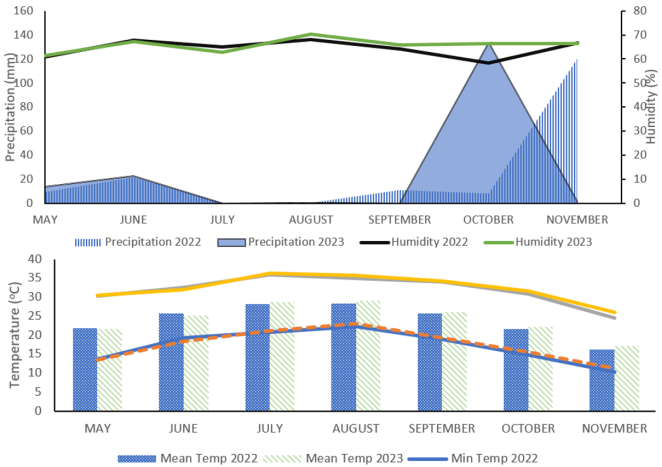
  • Abstract
  • Keywords
  • Document Sections

    1. 1. Introduction
    2. 2. Materials and Methods
    3. 3. Results
    4. 4. Discussion
    5. 5. Conclusions
    Show Full Outline
  • Abbreviations
  • Acknowledgments
  • Author Contributions
  • Funding
  • Data Availability Statement
  • Conflicts of Interest
  • References
  • Cite This Article
  • Author Information