Research Article | | Peer-Reviewed

Agromorphological Evaluation and Selection of High-performing Okra (Abelmoschus esculentus L.) Lines for Variety Development in Burkina Faso

Received: 13 July 2026     Accepted: 24 July 2026     Published: 17 August 2026
Views:       Downloads:
Abstract

Okra [Abelmoschus esculentus (L.) Moench] is a widespread traditional vegetable in Burkina Faso, whose fruits are rich in trace elements, vitamins, fiber, and mucilage. Despite favorable soil and climatic conditions, production remains low due to socio-cultural constraints and a lack of high-performing, adapted varieties. To identify okra lines with superior agromorphologique performance and potential for varietal selection, eight lines seven from Burkina Faso (V1, V2, V3, V4, V5, V6 and V8) and one from Mali (V7) were characterized using a randomized complete block design (RCBD) with three replications. Data were collected on nine qualitative and sixteen quantitative traits. The results showed variability in stem, fruit, and seed characteristics. Indeed, the most significant variations in phenotypic traits were observed in stem and fruit coloration, seed weight per plant, immature fruit weight, and seed yield. Lines V3, V5, V7, and V8 exhibited desirable traits, notably earliness, large leaf size, fruit coloration, a high number of seeds per fruit, high seed weight, and high yield and could be used in a hybridization program to develop okra varieties that combine a maximum of desired characteristics. Seed yield (SY) showed the highest heritability associated with the most significant genetic gain. This combination indicates strong additive gene action, suggesting that direct selection of the best lines based on field performance will allow for rapid and significant improvement in okra productivity.

Published in International Journal of Applied Agricultural Sciences (Volume 12, Issue 4)
DOI 10.11648/j.ijaas.20261204.14
Page(s) 141-151
Creative Commons

This is an Open Access article, distributed under the terms of the Creative Commons Attribution 4.0 International License (http://creativecommons.org/licenses/by/4.0/), which permits unrestricted use, distribution and reproduction in any medium or format, provided the original work is properly cited.

Copyright

Copyright © The Author(s), 2026. Published by Science Publishing Group

Keywords

Characterization, Lines of Interest, Varietal Improvement, Okra

1. Introduction
Like other countries in the sub-region, Burkina Faso’s economy relies essentially on agriculture, a sector that employs 74% of the population . Burkinabè agriculture is largely dominated by food staples (corn, sorghum, rice, and millet), which alone account for nearly 70% of the total annual cultivated area . However, this production remains insufficient to guarantee self-sufficiency and prevent recurring food and nutritional crises .
Increased production and promotion of neglected food plants like okra could help improve nutritional security and combat poverty . Indeed, nutritionists advocate for the use of okra in dietary diversification projects given its nutritional potential . Okra is a fruit vegetable rich in calcium, iron, protein, vitamins A and C, and magnesium, which serve as valuable dietary supplements for cereal-based meals in Burkina Faso . Nevertheless, this traditional vegetable has long been neglected by research in Burkina Faso and is still largely perceived as a crop grown by women, generally on very small plots near homesteads and often in refuse areas . Consequently, national okra production remains low, totaling 23,871 tons in 2020 , despite favorable soil and climatic conditions . In addition to socio-cultural constraints, this low production is explained by several other factors, including the lack of high-performing and adapted varieties . To date, only one okra variety is officially registered in the national catalog of agricultural species and varieties. Developing high-performing lines adapted to local conditions remains a major challenge. This study aims to characterize okra lines to select the most productive genotypes, thereby contributing to varietal improvement and promoting the okra sector in Burkina Faso.
2. Materials and Methods
2.1. Plant Material
The plant material used consists of eight okra lines, six of which were provided by INERA and one of Malian origin. Table 1 presents the list of okra lines studied according to their origin.
Table 1. List of okra lines studied.

Varieties

Abbreviation

Origin

AVOK1558-2-4

V1

Burkina Faso

AVOK155914

V2

Burkina Faso

AVOK157971

V3

Burkina Faso

Koni

V4

Burkina Faso

PI248999

V5

Burkina Faso

PI489847

V6

Burkina Faso

SASSILON

V7

Mali

TOT6000

V8

Burkina Faso

2.2. Study Site
The study was conducted at the Saria research station of the Institute for Environment and Agricultural Research (INERA) (12.267° N, 2.150° W; 300 m elevation). The Saria station is located 80 km west of Ouagadougou, within the North-Sudanian zone between the 700- and 900-mm isohyets. The soil is a leached tropical ferruginous type, deficient in phosphorus and low in organic matter, with a sandy-clay texture.
2.3. Experimental Design and Trial Management
The study followed a Randomized Complete Block Design (RCBD) with three replications. Each replication consisted of eight elementary plots. Each plot, measuring 7.2 m2 (3 m × 2.4 m), comprised four sowing rows spaced 80 cm apart. Sowing was performed at a rate of three seeds per hole, with 40 cm spacing between holes within each row. Replications were separated by a 1.5 m walkway, and a 1.5 m buffer was maintained between elementary plots.
Crop management included two hoeings performed at 14 and 28 days after sowing (DAS), supplemented by manual weeding as needed to control weed growth. At the seedling stage, plants were thinned to one per hole at 14 DAS. Mineral fertilization consisted of an NPK application (14% N, 23% P, 14% K) at a rate of 100 kg/ha at 14 DAS, followed by urea at a rate of 50 kg/ha at 35 DAS. Two phytosanitary treatments were applied: the first at flowering using Pacha (Acetamiprid 10 g/L), and the second during fruit formation using K-OPTIMAL (Acetamiprid 20 g/L, Lambda-cyhalothrin 15 g/L), to limit damage caused by pests and diseases.
2.4. Data Collection
2.4.1. Qualitative Traits
Qualitative traits observed across all plants of each line focused on the color of the leaf blade (COL), stem (COT), fruit (COF), and seeds (COG); the shapes of the leaf blades (FOL), fruit apex (FOA), and fruit (FOF); and the pubescence of the stem (PUT) and immature fruits (PUF).
2.4.2. Quantitative Traits
(i). Phenological Traits
1) Days to flowering (DTF): the number of days from sowing to the day when at least one plant flowered in the elementary plot;
2) Days to 50% flowering (DTF50%): the number of days from sowing to the day when at least half (50%) of the plants in the elementary plot have flowered;
3) Days to immature fruit (DIF): the number of days from sowing to the day when at least one plant bears an immature fruit in the elementary plot;
4) Days to maturity (DTM): the number of days from sowing to the day when at least one plant bears a mature fruit in the elementary plot;
(ii). Growth Traits
1) Leaf blade length (LOL) and width (LAL) in cm: measured using a tape measure on the eighth leaf of the plant;
2) Immature fruit length (LOI) in cm: measured using a tape measure on immature fruit from a sample of three plants;
3) Number of nodes at maturity (NNA): determined by counting the number of nodes present on the plant at maturity.
4) Number of ridges per fruit at maturity (NAF): obtained by counting the number of longitudinal ridges on each mature fruit.
2.5. Data Analysis
The collected data were processed using Excel 2019, which was also used to create the charts. An analysis of variance (ANOVA) followed by a comparison of means using the Tukey HSD test, which was performed using RStudio version 4.4.1 at a 5% significance level. The ANOVA was based on a general linear model for a randomized complete block design according to:
Yij=μ+Ri+Gj+εij(1)
where Yij is the observed value for the genotype i.
in replicate j, μ is the grand mean,
R is the fixed effect of the replicate j, G is the fixed effect of the genotype i and εij s the experimental error (residual) associated with the observation.
Similarly, RStudio software was used to perform Pearson correlation tests to evaluate the associations between the studied traits and grain yield. Genetic parameters, specifically genotypic (σ2G) and phenotypic variances (σ2P) were calculated using the following formulas:
σG2=MSg-MSer(2)
where MSg is the genotype mean square, MSe is the error (residual) mean square from the ANOVA, and r is the number of replicates;
σP2=σG2+σE2 (MSe)(3)
σE2 is the residual variance or mean square error (MSe).
Broad-sense heritability (H2) was estimated according to the method of Johnson et al. (1955) and classified as low (H2< 30%), moderate (30% ≤ H2 ≤ 60%) or high (H2 > 60%).
H2= σG2σG2 + σE2r(4)
Expected genetic advance (GA) and genetic advance as a percentage of the mean (GAM%) were estimated according to the method of . The selection intensity (K), treated as a constant, is equal to 2.06, which corresponds to a 5% selection intensity."
GA=K×σG2×H2(5)
GA%=K× σG2X̅×H2 ×100(6)
3. Results
3.1. Variation in Qualitative Traits of Okra Lines
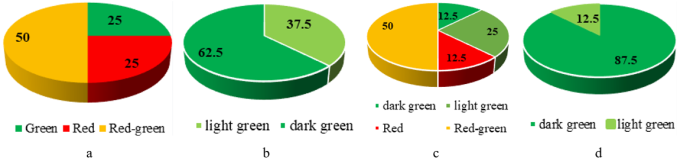
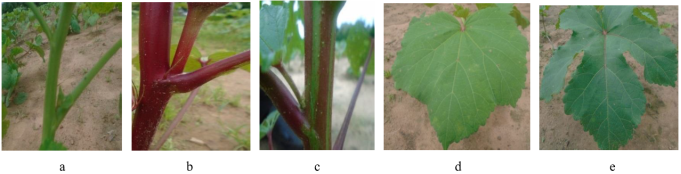
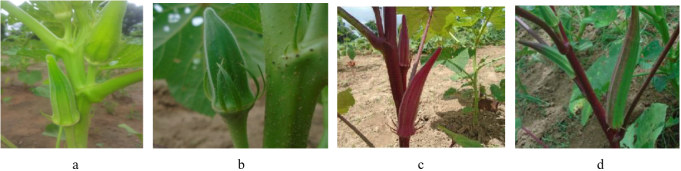
The evaluation of qualitative traits revealed variation in the color (Figure 1), shape (Figure 2), and pubescence (Figure 3) of the organs among the studied okra lines. Regarding organ coloration, red-green stems were the most frequent (50%), while entirely green (25%) and red (25%) stems were observed in smaller proportions (Figure 4). The leaf blades were primarily dark green (62.5%) (Figure 4e). Great variability was observed in fruit color (Figure 5). Light green, dark green, red, and green-striped red fruits were observed, with a predominance of lines featuring green-striped red fruits (50%). As for the okra seeds, the majority of the lines feature dark green seeds (87.5%).
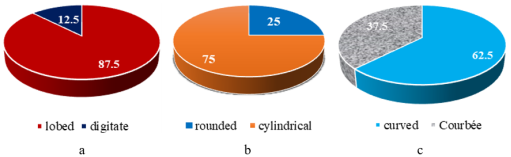
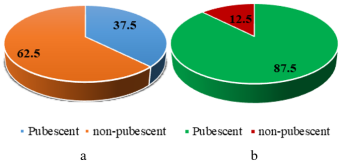
Regarding the shape of the leaf blades, fruits, and fruit apices, two main types were distinguished in each case (Figure 2). A high proportion of the lines featured lobed leaf blades (87.5%) and cylindrical fruits (75%) with pointed apices (62.5%). Similarly, two types were observed for stem and fruit pubescence (Figure 3). A large majority of the lines exhibited glabrous or non-pubescent stems (62.5%), while a high proportion of the lines had pubescent fruits (87.5%).
Figure 1. Variation in the color of stems (a), leaves (b), fruits (c), and seeds (d).
Figure 2. Variation in the shapes of the leaf blade (a), fruit (b), and fruit apex (c).
Figure 3. Stem (a) and fruits (b) Pubescence.
Figure 4. Variations in stem and leaf coloration and leaf shapes: (a) green stem, (b) red stem, (c) red-green stem, (d) light green leaf with lobed blade, (e) dark green leaf with digitate blade.
Figure 5. Variation in fruit coloration: (a) light green fruit, (b) dark green fruit, (c) red fruit, (d) red-green fruit.
3.2. Variation in Quantitative Traits of Okra Lines
3.2.1. Variation in Phenotypic Traits
Table 2 presents the variation of the studied phenotypic traits. The results of the analysis of variance revealed significant differences (P < 0.05) among the lines for most quantitative traits. However, the lines exhibited number of nodes at maturity and 100-seed weights that were statistically equal (P > 0.05). The greatest variations in phenotypic traits were observed for seed weight per plant (CV = 28,19%) which ranged from 2.29 to 7.26 g; seed yield (CV = 28,18%) which fluctuated between 143.38 and 453.75 kg ha⁻1; immature fruit weight (CV = 24,14%) with values ranging from 9.23 to 24.46 g; and number of immature fruits per plant (CV = 22,93%) which varied from 2 to 4.66.
Table 2. Variation in quantitative phenotypic traits.

Variable

Minimum

Maximum

Mean ± SD

C.V.

F

P

CSF

45.00

66.00

58.25±6.32

10.85

132.27

0.0000

CSF50

55.00

82.00

72.71±8.07

11.10

216.73

0.0000

CSI

57.00

72.00

64.17±4.41

6.87

60.37

0.0000

LOI

6.90

13.06

10.64±1.79

16.79

16.57

0.0000

PFI

9.23

24.46

16.08±3.88

24.14

79.49

0.0000

LOL

9.66

17.66

13.1±1.71

13.09

22.60

0.0000

LAL

12.83

17.66

15.71±1.38

8.81

8.88

0.0003

CSM

73.00

97.00

87.42±7.03

8.04

173.70

0.0000

NNA

8.33

12.33

10.03±1.09

10.91

2.10

0.1118

NIP

2.00

4.66

3.05±0.70

22.93

4.10

0.0119

NGF

58.33

88.66

71.33±9.58

13.44

466.81

0.0000

NAF

5.00

10.00

7.16±1.25

17.47

8.78

0.0003

PGP

2.29

7.26

5.20±1.46

28.19

91.73

0.0000

P100

4.80

7.20

5.65±0.50

8.84

1.35

0.2988

RDG

143.38

453.75

324.68±91.48

28.18

91.86

0.0000

Sowing to Flowering Cycles: CSF: Sowing-to-flowering cycleCSF50: Days to 50% flowering CSI: Sowing-to-immature fruit formation cycle CSM: Sowing-to-maturity cycle Morphological & Yield Traits: CV: Coefficient of variation LOL: Leaf blade length LAL: Leaf blade width LOI: Immature fruit length NNA: Number of nodes at maturity PFI: Immature fruit weight NIP: Number of immature fruits per plant NFP: Number of mature fruits per plant NGF: Number of seeds per fruit NAF: Number of ridges per fruit at maturity RDG: Seed yield Statistical Terms: F: Fisher's F-value P: Probability (\(P\)-value) P > 0.05: Non-significant differences (ns) P < 0.05: Significant differences P < 0.01: Highly significant differences P < 0.001: Very highly significant differences.
3.2.2. Estimation of Genetic Parameters
The estimation of genetic parameters is presented in Table 3. Analysis of these parameters reveals significant variability among the traits studied. Broad-sense heritability (H2) estimates are generally high for the majority of the variables, with values ranging from 0.89 to 1.00 for CSF, CSF50, CSI, LOI, LOL, CSM, NGF, NAF, and RDG. These values indicate a strong contribution of genetic variance to phenotypic variance, which is confirmed by the proximity between σG2 and σP2 for these traits, suggesting a low influence of environmental factors. Furthermore, the expected genetic advances (GA) and relative (GA%) vary considerably depending on the traits. The RDG trait shows the highest absolute genetic advance (193.4) and relative genetic advance (59.56%), indicating a very significant potential for improvement. High relative genetic advances were also observed for LOI (32.80%), NIP (31.48%), NAF (30,03%), and NGF (28,87%), reflecting a favorable response to selection. The traits CSF, CSF50, and CSM show high heritability values (≥ 0,99) associated with moderate to high relative genetic advances (17.23 to 23.85%), indicating predominantly additive genetic control and a strong potential for progress through selection. In contrast, the CSI trait, despite having high heritability (0.98), recorded a more moderate relative genetic advance (14.24%), suggesting slower progress.
Conversely, the traits NNA and P100 exhibit low heritability (0.52 and 0.26, respectively) accompanied by low relative genetic advances (8.67% and 3.19%), reflecting a strong environmental influence and limited potential for improvement through selection.
Table 3. Genetic parameters of the quantitative traits studied.

Variable

H2

σG2

σP2

GA

GA (%)

CSF

0.99

42.71

43.04

13.37

22.95

CSF50

0.99

70.20

70.52

17.34

23.85

CSI

0.98

20.26

20.60

9.14

14.24

LOI

0.94

2.89

3.07

3.49

32.80

LOLI

0.96

2.65

2.77

3.4

25.95

CSM

0.99

53.11

53.42

15.06

17.23

NNA

0.52

0.34

0.66

0.87

8.67

NIP

0.76

0.27

0.35

0.96

31.48

NGF

0.99

99.95

100.17

20.6

28.87

NAFM

0.89

1.22

1.38

2.15

30.03

P100

0.26

0.03

0.11

0.18

3.19

RDG

0.99

8791.51

8888.27

193.4

59.56

H2: Broad-sense heritability, σG2: Genotypic variance, σP2: Phenotypic variance, GA: Expected genetic advance, GA (%): Genetic advance as a percentage of the mean
3.3. Correlation Between the Quantitative Traits Studied
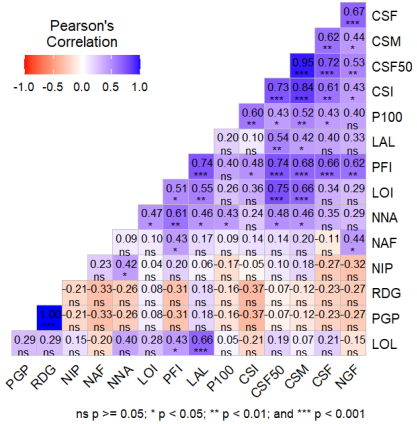
Pearson correlation analysis highlights variable relationships between the studied traits, with a predominance of positive correlations (Figure 6). Strong to very strong positive correlations. (r ≥ 0,70) were observed between the days to 50% flowering and the sowing-to-immature fruit formation cycle (r = 0,95; p < 0,001), and immature fruit length (r = 0,75; p < 0,001) and immature fruit weight (r = 0,74; p < 0,001), suggesting a strong interdependence between these variables. Similarly, the sowing-to-immature fruit formation cycle is strongly correlated with the length (r = 0,74; p < 0,001) and weight (r = 0,68; p < 0,001) of the immature fruit, indicating that these traits evolve jointly. The number of seeds per fruit trait also shows a significant positive correlation with the sowing-to-flowering cycle (r = 0,67; p < 0,001), suggesting that the improvement of these traits could be achieved simultaneously. Conversely, some weak to negative correlations were observed, particularly for RDG and PGP, which show generally low and non-significant coefficients (p ≥ 0,05) with the majority of traits. These results suggest a relative independence of these variables from the other studied traits. Furthermore, several correlations are non-significant (p ≥ 0,05), notably involving NIP, NAF, and NNA, indicating an absence of a stable linear relationship with the other traits, likely due to strong environmental influence or high intrinsic variability.
Figure 6. Pearson correlation coefficients.
3.4. Comparison of Line Performance for Phenology-Related Traits
The results of the mean separation test for traits by line are presented in Table 4. Variety V8 was the earliest maturing, with cycles of 45.7 days for sowing-to-first flower formation, 66.3 days for sowing-to-50% flowering, and 57.7 days for sowing-to-fruit, and the shortest sowing-to-maturity period (81.7 days). In contrast, the longest cycles were recorded for varieties V3 (65.3 days) and V1 (63 days) regarding days to first flowering; for V3 in days to 50% flowering (81.7 days); for V6 (70.7 days) and V3 (69 days) for fruit formation; and for V3 (94.7 days) and V2 (90.3 days) for maturity.
Table 4. Performance of okra lines for phenological traits.

Varieties

CSF (JAS)

CSF50 (JAS)

CSI (JAS)

CSM (JAS)

V1

63ab

77b

66.3bc

89.7b

V2

57.7c

73.7c

66c

90.3a

V3

65.3a

81.7a

69ab

94.7a

V4

52d

55.7e

60de

73.7b

V5

62b

71c

61.7d

84.3c

V6

58c

78.7b

70.7a

96a

V7

62.3b

77.7b

62d

89b

V8

45.7e

66.3d

57.7e

81.7c

CSF: Sowing-to-flowering cycleCSF50: Days to 50% flowering CSI: Sowing-to-immature fruit formation cycle CSM: Sowing-to-maturity cycle JAS: Days after sowing (DAS)
3.5. Comparison of Line Performance for Growth-Related Traits
The results of the mean separation test for growth traits across lines are presented in Table 5. Variety V5 exhibited the longest leaf blades (16.5 cm), while V4 exhibited the shortest leaf blades (10.72 cm). Nearly all varieties had leaf blades of statistically equal widths (15.24 - 17.11 cm), which were nevertheless greater than the blades of variety V4 (13.21 cm). Fruit length ranged from 11.99 cm for variety V1 to 7.01 cm for variety V4. Variety V3 exhibited fruits with the highest number of ridges (9.11), while V1 had fruits with the lowest number of ridges (5.11). Regarding the number of nodes, no significant difference was observed among the varieties.
Table 5. Comparison of okra lines for growth traits.

Varieties

LOL (cm)

LAL (cm)

LOI (cm)

NAF

NNA

V1

12.85bc

15.11ab

11.99a

5.11c

10.3a

V2

13.02bc

15.24ab

9.27b

7.22ab

9.9a

V3

13.08bc

16.84a

12.27a

9.11a

11.6a

V4

10.72d

13.21b

7.01c

7.11b

8.7a

V5

16.50a

17.11a

10.34ab

6.11bc

10.2a

V6

11.83cd

15.33ab

11.40ab

7.44ab

9.6a

V7

13.00bc

16.78a

11.33ab

7.44ab

9.9a

V8

13.81b

16.04a

11.55a

7.78ab

10.1a

LOL: Leaf blade length (Leaf length) LAL: Leaf blade width (Leaf width) LOI: Immature fruit length NNA: Number of nodes at maturity
3.6. Comparison of Line Performance for Yield Component Traits
Table 6 presents the average performance of the studied okra lines for fruit and seed-related traits. Variety V2 exhibited the highest number of immature fruits per plant (4.11), while V4 recorded the lowest number of fruits (2.44). Variety V3 recorded the highest values for the number of seeds per fruit (88.11) and immature fruit weight (23.45 g), whereas V8 exhibited the lowest number of seeds per fruit (58.44 seeds) and V4 recorded the lowest value for immature fruit weight (9.75 g). The best performances for seed weight per plant and seed yield were recorded by variety V7, with respective values of 6.93 g and 432.95 kg/ha. In contrast, variety V3 recorded the lowest values, with a seed weight of 2.43 g and a seed yield of 152.15 kg/ha.
Table 6. Comparison of okra lines for fruit and seed-related traits.

Varieties

NIP

NGF

PFI (g)

PGP (g)

P100 (g)

RDG (kg/ha)

V1

2.77ab

67.22e

13.90d

4.80c

5.67

300.12c

V2

4.11a

63.55f

17.2bc

4.20c

5.57

262.74c

V3

3.18ab

88.11a

23.45a

2.43d

6.10

152.15d

V4

2.44b

69.55d

9.75e

4.38c

5.37

273.87c

V5

2.66ab

67.55de

17.96b

6.42ab

5.63

401.25ab

V6

2.66ab

72.33c

15.16cd

6.26ab

6.13

391.01ab

V7

2.77ab

83.89b

17.53b

6.93a

5.60

432.95a

V8

3.77ab

58.44g

13.69d

6.13a

5.17

383.38b

NIP: Number of immature fruits per plant NAFM: Number of ridges per fruit at maturity NGF: Number of seeds per fruit PFI: Immature fruit weight PGP: Seed weight per plantP100: 100-seed weight RDG: Seed yield
4. Discussion
The present study revealed significant agro-morphological variability among the evaluated okra lines, reflecting the existence of exploitable genetic diversity for varietal improvement. The highest variations observed in the studied qualitative and quantitative traits are reflected in the multitude of stem and fruit colorations, fruit and seed weight, and seed yield. This variability, which primarily concerns fruit and seed-related traits, confirms previous observations made in Burkina Faso, where broad phenotypic diversity has been reported in okra .
This diversity could result from both farmer-led selection focused on traits of interest, particularly those related to fruit, and adaptation to local agro-ecological conditions . High broad-sense heritability estimates (H2 ≥ 0.89) observed for the majority of traits, notably NGF, CSF50, CSF, CSM, and RDG, associated with high expected genetic advance values, indicate a predominance of additive genetic effects in the control of these traits. According to Falconer and Mackay (1996), a combination of high heritability and high genetic advance is a reliable indicator of the effectiveness of phenotype-based selection. These results suggest that these traits can be effectively improved through direct selection methods, even at an early stage of breeding programs. Similar results have been reported in okra by other authors, who showed that traits related to yield and its components generally exhibit high heritability and a strong potential for selection response . Conversely, the low heritability and genetic advance values observed for traits such as NNA and P100 reflect a significant influence of environmental factors or non-additive genetic effects. In such cases, direct selection becomes less effective, and alternative approaches such as recurrent selection or multi-environment evaluation are recommended . These results underscore the importance of simultaneously considering genetic parameters to guide varietal improvement strategies. Pearson correlation analysis complemented this approach by highlighting significant relationships between several traits. The strong positive correlations observed between phenological traits (CSF, CSF50, CSI) and growth and yield traits (LOI, PFI) suggest a functional or genetic interdependence between these traits. These associations could be attributed to pleiotropy or genetic linkage, as reported by . From a practical standpoint, these positive correlations indicate that selection for a given trait could lead to the simultaneous improvement of other associated traits, which constitutes a major advantage in breeding programs . However, the lack of significant correlation between certain traits, notably seed yield (RDG) and several yield components, suggests that these traits are partially independent and may be controlled by distinct genetic mechanisms. This independence implies that improving these traits will require specific and targeted selection. Similar observations have been made in other vegetable crops, where yield appears as a complex trait influenced by multiple factors . The results of this study identify lines V3, V5, V7, and V8 as lines of interest that are the most high-performing based on a combination of agronomic and genetic criteria. The earliness observed in V8 constitutes a major asset in Sahelian contexts characterized by high climate variability and short rainy seasons. Furthermore, the high performance of V5 for leaf dimensions, those of V7 in terms of yield and seed weight, as well as those of V3 for seed number and fruit weight, confirm their potential as parents in hybridization programs. These results are in agreement with the work of other authors, who emphasized the importance of fruit and seed-related traits in the varietal preferences of producers and consumers . Indeed, these authors identified, through participatory varietal selection, cycle earliness, fruit color, and elongated shape, as well as the number of fruits per plant and the number of seeds per fruit, as the primary traits of interest for okra in Burkina Faso. Furthermore, highlighted the value of genotypes characterized by large leaf dimensions in the fight against malnutrition, due to the high mineral salt content of the leaves, which increases proportionally with their size.
Although the results obtained are promising, certain limitations must be taken into account. The study was conducted at a single site and during a single growing season, which does not allow for an assessment of the stability of the lines’ performance under varying conditions. However, the genotype × environment interaction plays a crucial role in the expression of quantitative traits . Multi-environmental trials would therefore be necessary to confirm the robustness of the identified lines.
5. Conclusion
This study highlighted significant agro-morphological variability among the evaluated okra lines. The traits NGF, CSF50, CSF, CSM, and RDG exhibited high heritability associated with substantial genetic gains, indicating predominantly additive genetic control and strong potential for improvement through selection. Significant positive correlations observed between several traits suggest the possibility of effective simultaneous selection. Lines V3, V5, V7, and V8 stand out for their agronomic performance, notably their earliness, large leaf dimensions, fruit coloration, high number of seeds per fruit, and high seed weight and yield. They thus constitute promising genetic resources for okra breeding programs.
Abbreviations

FAO

Food and Agriculture Organization

RCBD

Randomized Complete Block Design

INSD

National Institute of Statistics and Demography

DGESS

Directorate General for Sectoral Studies and Statistics

MARAH

Ministry of Agriculture, Animals and Fisheries Resources

Acknowledgments
The authors would like to thank the Institute of Environment and Agricultural Research (INERA) and the National Center for Scientific and Technological Research (CNRST) for providing the experimental materials and facilities. We also extend our gratitude to Joseph KI-ZERBO University for its valuable collaboration throughout this study.
Author Contributions
Hamadou Sidibe: Conceptualization, Funding acquisition, Methodology, Resources, Writing – review & editing
Brahime Tingueri: Data curation, Formal Analysis, Validation, Writing – original draft, Writing – review & editing
Vonogo Nikodeme Kabre: Methodology, review & editing
Daouda Ouedraogo: Data curation, Writing – review & editing, Data curation
Mahamadou Sawadogo: Supervision, Validation
Funding
This work was supported by INERA and the University through student training and supervision agreements.
Conflicts of Interest
The authors declare no conflicts of interest.
References
[1] INSD. Fifth General Population and Housing Census of Burkina Faso. Summary of Final Results, 2022, 133 p.
[2] DGESS/MARAH. Yearbook of Agro-Sylvo-Pastoral Statistics, Report, Burkina Faso, 2024, 540 p.
[3] Ouedraogo, M. H. Study of the genetic diversity of okra (Abelmoschus esculentus) cultivated in Burkina Faso. Ph.D. Thesis, Joseph KI-ZERBO University, 2016.
[4] Hamon, S. Evolutionary organization of the genus Abelmoschus (okra). Coadaptation and evolution of two cultivated okra species in West Africa, A. esculentus and A. caillei. Paris, France: ORSTOM; 1988, 191 pp.
[5] Nzikou, J. M., Mvoula, T., Matouba, E., Ouamba, J. M., Kapseu, C., Parmentier, M., Desobry, S. A study on gumbo seed grown in Congo Brazzaville for its food and industrial applications. African Journal of Biotechnology, 2006, 5(24), 2469-2475.
[6] Kumar, S., Dagnoko, S., Haougui, A., Ratnadass, A. Okra (Abelmoschus spp.) in West and Central Africa: Potential and progress on its improvement. African Journal of Agricultural Research, 2010, 25, 3590-3598.
[7] Doumbia S. Seasonal products, Fresh okra, Les Echos, 2010.
[8] Sawadogo, N., Nebie, B., Kiebre, M., Kando-Bationo, P. Agro-morphological characterization of sweet-grain sorghums (Sorghum bicolor (L.) Moench) of Burkina Faso. International Journal of Biological and Chemical Sciences, 2014, 8(5), 2183-2197.
[9] Bationo/Kando P., Zongo J. D., Ouedraogo M., Nanema K. R., Traore E. R. Study of the agro-morphological variability of okra (Abelmoschus spp.) from the West-Central agricultural region of Burkina Faso. Annals of the University of Ouagadougou - Series C, 2007, 5, 1-12.
[10] FAO. Statistical database, Food and Agriculture Organization of the United Nations. Available from:
[11] Nana, R., Zombre G., Tamini, Z., Sawadogo, M. Effect of water regime on okra yields in off-season cultivation. Sciences & Nature, 2009, 6(2), 107-116.
[12] Sawadogo, M., Ouedraogo, J. T., Balma, D., Ouedraogo, M. The use of cross-species SSR primers to study genetic diversity of okra from Burkina Faso. African Journal of Biotechnology, 2009, 8, 2476-248.
[13] Ouedraogo, M. H., Bougma, L. A., Sawadogo, N., Kiebre, Z., Ouedraogo, N., Traore, E. R., Nanema, R. K., Bationo/Kando, P., Sawadogo, M. Assessment of agromorphological performances and genetic parameters of okra varieties resulting from participative selection. International Journal of Advanced Research, 2016, 4(3), 1554 -1564.
[14] Johnson, H. W., Robinson, H. F., Comstock, R. E. Estimates of genetic and environmental variability. Agronomy Journal, 1955, 47, 314-318.
[15] Assefa, K., Ketema, S., Tefera, H., Nguyen, H. T., Blum, A., Ayele, M. Diversity among Germplasm Lines of the Ethiopian Cereal Tef [Eragrostis tef (Zucc.) Trotter]. Euphytica, 1999, 106, 87-97.
[16] Jiro, H., Sawadogo, M., Millogo, J. Agro-morphological and anatomical characterizations of okra from Yatenga and their link with the local nomenclature of varieties. Sciences & Nature, 2011, 8(1), 23-36.
[17] Falconer, D. S., Mackay, T. F. C. Introduction to Quantitative Genetics (3rd Edition). Longman Scientific and Technical, Harlow; 1996, 448 p.
[18] Allard, R. W. Principles of Plant Breeding. New York, Editor: John Wiley & Sons. 1960, 485 p.
[19] Singh, R. K., Chaudhary, B. D. Biometrical Methods in Quantitative Genetic Analysis. Kalyani Publishers, 1979, 55-57.
[20] Sawadogo, M., Balma, D., Nana, R., Somda, M. K. Agro-morphological and Commercial Diversity of Okra (Abelmoschus esculentus L.) in and around Ouagadougou. International Journal of Biological and Chemical Sciences, 2009, 3(2), 326-336.
[21] Sawadogo, M., Balma, D., Zombre, G. Expression of different okra ecotypes (A. esculentus (L.)) under water deficit occurring during budding and flowering. BASE, Biotechnology, Agronomy, Society, Environment, 2006, 10(1), 43-54.
Cite This Article
  • APA Style

    Sidibe, H., Tingueri, B., Kabre, V. N., Ouedraogo, D., Sawadogo, M. (2026). Agromorphological Evaluation and Selection of High-performing Okra (Abelmoschus esculentus L.) Lines for Variety Development in Burkina Faso. International Journal of Applied Agricultural Sciences, 12(4), 141-151. https://doi.org/10.11648/j.ijaas.20261204.14

    Copy | Download

    ACS Style

    Sidibe, H.; Tingueri, B.; Kabre, V. N.; Ouedraogo, D.; Sawadogo, M. Agromorphological Evaluation and Selection of High-performing Okra (Abelmoschus esculentus L.) Lines for Variety Development in Burkina Faso. Int. J. Appl. Agric. Sci. 2026, 12(4), 141-151. doi: 10.11648/j.ijaas.20261204.14

    Copy | Download

    AMA Style

    Sidibe H, Tingueri B, Kabre VN, Ouedraogo D, Sawadogo M. Agromorphological Evaluation and Selection of High-performing Okra (Abelmoschus esculentus L.) Lines for Variety Development in Burkina Faso. Int J Appl Agric Sci. 2026;12(4):141-151. doi: 10.11648/j.ijaas.20261204.14

    Copy | Download

  • @article{10.11648/j.ijaas.20261204.14,
      author = {Hamadou Sidibe and Brahime Tingueri and Vonogo Nikodeme Kabre and Daouda Ouedraogo and Mahamadou Sawadogo},
      title = {Agromorphological Evaluation and Selection of 
    High-performing Okra (Abelmoschus esculentus L.) Lines for Variety Development in Burkina Faso},
      journal = {International Journal of Applied Agricultural Sciences},
      volume = {12},
      number = {4},
      pages = {141-151},
      doi = {10.11648/j.ijaas.20261204.14},
      url = {https://doi.org/10.11648/j.ijaas.20261204.14},
      eprint = {https://article.sciencepublishinggroup.com/pdf/10.11648.j.ijaas.20261204.14},
      abstract = {Okra [Abelmoschus esculentus (L.) Moench] is a widespread traditional vegetable in Burkina Faso, whose fruits are rich in trace elements, vitamins, fiber, and mucilage. Despite favorable soil and climatic conditions, production remains low due to socio-cultural constraints and a lack of high-performing, adapted varieties. To identify okra lines with superior agromorphologique performance and potential for varietal selection, eight lines seven from Burkina Faso (V1, V2, V3, V4, V5, V6 and V8) and one from Mali (V7) were characterized using a randomized complete block design (RCBD) with three replications. Data were collected on nine qualitative and sixteen quantitative traits. The results showed variability in stem, fruit, and seed characteristics. Indeed, the most significant variations in phenotypic traits were observed in stem and fruit coloration, seed weight per plant, immature fruit weight, and seed yield. Lines V3, V5, V7, and V8 exhibited desirable traits, notably earliness, large leaf size, fruit coloration, a high number of seeds per fruit, high seed weight, and high yield and could be used in a hybridization program to develop okra varieties that combine a maximum of desired characteristics. Seed yield (SY) showed the highest heritability associated with the most significant genetic gain. This combination indicates strong additive gene action, suggesting that direct selection of the best lines based on field performance will allow for rapid and significant improvement in okra productivity.},
     year = {2026}
    }
    

    Copy | Download

  • TY  - JOUR
    T1  - Agromorphological Evaluation and Selection of 
    High-performing Okra (Abelmoschus esculentus L.) Lines for Variety Development in Burkina Faso
    AU  - Hamadou Sidibe
    AU  - Brahime Tingueri
    AU  - Vonogo Nikodeme Kabre
    AU  - Daouda Ouedraogo
    AU  - Mahamadou Sawadogo
    Y1  - 2026/08/17
    PY  - 2026
    N1  - https://doi.org/10.11648/j.ijaas.20261204.14
    DO  - 10.11648/j.ijaas.20261204.14
    T2  - International Journal of Applied Agricultural Sciences
    JF  - International Journal of Applied Agricultural Sciences
    JO  - International Journal of Applied Agricultural Sciences
    SP  - 141
    EP  - 151
    PB  - Science Publishing Group
    SN  - 2469-7885
    UR  - https://doi.org/10.11648/j.ijaas.20261204.14
    AB  - Okra [Abelmoschus esculentus (L.) Moench] is a widespread traditional vegetable in Burkina Faso, whose fruits are rich in trace elements, vitamins, fiber, and mucilage. Despite favorable soil and climatic conditions, production remains low due to socio-cultural constraints and a lack of high-performing, adapted varieties. To identify okra lines with superior agromorphologique performance and potential for varietal selection, eight lines seven from Burkina Faso (V1, V2, V3, V4, V5, V6 and V8) and one from Mali (V7) were characterized using a randomized complete block design (RCBD) with three replications. Data were collected on nine qualitative and sixteen quantitative traits. The results showed variability in stem, fruit, and seed characteristics. Indeed, the most significant variations in phenotypic traits were observed in stem and fruit coloration, seed weight per plant, immature fruit weight, and seed yield. Lines V3, V5, V7, and V8 exhibited desirable traits, notably earliness, large leaf size, fruit coloration, a high number of seeds per fruit, high seed weight, and high yield and could be used in a hybridization program to develop okra varieties that combine a maximum of desired characteristics. Seed yield (SY) showed the highest heritability associated with the most significant genetic gain. This combination indicates strong additive gene action, suggesting that direct selection of the best lines based on field performance will allow for rapid and significant improvement in okra productivity.
    VL  - 12
    IS  - 4
    ER  - 

    Copy | Download

Author Information
  • Department of Crop Production, Institute of Environment and Agricultural Research/National Center for Scientific and Technological Research, Ouagadougou, Burkina Faso

    Biography: Hamadou Sidibe is a plant breeder at Environmental and Agricultural Research Institute, He completed his PhD in Genetics and Plant Breeding from Joseph KI-ZERBO University in 2020, and his Master degree in Breeding and Valorization of Plant Genetic Resources from the same university in 2015. In addition, he is a member of the Plant Genetics and Breeding Team at Joseph KI-ZERBO University and OFAB’ Burkina chapter coordinator.

    Research Fields: Plants breeding, genetics.

  • General Directorate of Crop Production, Ministry of Agriculture, Water, Animal Resources and Fisheries, Ouagadougou, Burkina Faso

    Biography: Brahime Tingueri is a Seed Certification and Seed Quality Control Officer at the Ministry of Agriculture, Water, Animal Resources, and Fisheries. He completed his PhD in Genetics and Plant Breeding from Joseph KI-ZERBO University in 2024, and his Master degree in Breeding and Valorization of Plant Genetic Resources from the same university in 2020. In addition, he is a member of the Plant Genetics and Breeding Team at Joseph KI-ZERBO University.

    Research Fields: Plants breeding, genetics, Seed quality and certification.

  • Department of Agrosylvopastoral Sciences, Norbert Zongo University/Manga University Center, Manga, Burkina Faso

    Biography: Vonogo Nikodeme Kabre is a scientist and researcher from Burkina Faso. He holds a PhD in Applied Biological Sciences (2019) and has served as a lecturer-researcher at the Manga University Center since 2020, where he has held the position of Director of Studies since July 2024. He is an Assistant Professor within the Genetics and Plant Breeding team at the Biosciences Laboratory (UFR-SVT) of Joseph KI-ZERBO University in Ouagadougou. His work focuses primarily on: plant genetic diversity (studying the genetic and phenotypic parameters of local crops) and the valorization of leafy vegetables (with research centering on the improvement and utilization of Kenaf—*Hibiscus cannabinus*, used for the dish "Babenda"—as well as amaranth and fonio).

  • Department of Crop Production, Institute of Environment and Agricultural Research/National Center for Scientific and Technological Research, Ouagadougou, Burkina Faso

    Biography: Daouda Ouedraogo is a seed breeding and preservation engineer at INERA in Burkina Faso. He earned his Master's degree in Seed Breeding and Preservation from Joseph KI-ZERBO University in Burkina Faso. In addition, he is a member of the research team for the oilseed and protein crop program within the plant production department at INERA

    Research Fields: Plants breeding, genetics.

  • Department of Plant Biology and Physiology, Joseph Ki-Zerbo University, Ouagadougou, Burkina Faso

    Biography: Mahamadou Sawadogo Full Professor, Genetics, Plant Breeding, Biotechnology, Biosafety, Unit of Training and Research in Life and Earth Sciences, Department: Plant Biology and Plant Physiology. He obtained his Specialist Master's Degree - Option: Genetics and Plant Breeding at the Patrice Lumumba Peoples' Friendship University of Russia, Moscow, Russia in 1993 and a PhD - Option: Genetics and Plant Breeding at the Patrice Lumumba Peoples' Friendship University of Russia, Moscow, Russia in 1996. He has participated in multiple international research collaboration projects in recent years.

    Research Fields: Plants breeding, genetics.

  • Abstract
  • Keywords
  • Document Sections

    1. 1. Introduction
    2. 2. Materials and Methods
    3. 3. Results
    4. 4. Discussion
    5. 5. Conclusion
    Show Full Outline
  • Abbreviations
  • Acknowledgments
  • Author Contributions
  • Funding
  • Conflicts of Interest
  • References
  • Cite This Article
  • Author Information