Abstract
Black pepper (Piper nigrum L.) is an economically important perennial spice crop in Tanzania, but the identity, phenotypic distinctness and yield-component characteristics of farmer-maintained planting materials remain poorly documented. This study characterized farmer-recognized black pepper genotypes using integrated vegetative, leaf, spike, berry and reproductive-mass descriptors. An observational on-farm blocked characterization study was conducted across nine farms in Morogoro, Tanga and Unguja. A total of 138 mature vines were assessed for 28 descriptors, comprising nine qualitative and 19 quantitative traits. Vine-level quantitative data were analyzed using linear mixed-effects models that accounted for farm-level clustering. Qualitative descriptors were analyzed using Fisher’s exact tests with Monte Carlo simulation and Cramér’s V. Relationships among traits and integrated phenotypic structure were examined using correlation analysis, principal component analysis, factor analysis of mixed data, Gower-distance clustering and PERMANOVA. Soil variability among the nine farms was examined exploratorily using principal component analysis. Strong genotype-associated differentiation was observed for spike length (F = 171.94, p < 0.001, partial η2 = 0.954), number of spikes per kilogram (F = 42.09, p < 0.001, partial η2 = 0.927), berry length (F = 62.96, p < 0.001, partial η2 = 0.901), berry-size index (F = 35.71, p < 0.001, partial η2 = 0.813) and leaf-size index (F = 33.79, p < 0.001, partial η2 = 0.796). BABUKUBWA expressed the longest spikes and largest leaves but comparatively light dry spikes. KATI had the greatest individual dry spike weight, BABUNDOGO had the greatest fresh weight of 100 spikes, ISMAILIA produced the most berries per spike, and NDEFU and KATI had the greatest 1,000-berry mass. Qualitative differentiation was strongest for spike shape (V = 0.909), spike setting (V = 0.806), leaf shape (V = 0.777), branching habit (V = 0.745) and leaf venation (V = 0.667). Multivariate analyses indicated that differentiation reflected integrated combinations of vegetative and reproductive traits, while farm-level clustering was pronounced for several vigour and reproductive-mass traits. Farmer-recognized black pepper genotypes in the surveyed production environments possessed coherent and multidimensional phenotypic profiles. Spike length alone did not predict reproductive mass, demonstrating that selection should integrate spike number, berry number, berry size, spike mass and dry recovery. The identified materials provide candidate germplasm for conservation and further evaluation, but morphological differentiation does not confirm genetic distinctness. Molecular characterization, and balanced multi-environment clonal trials are required before the materials can be recognized as distinct cultivars or recommended for formal release.
Keywords
Black Pepper, Farmer-recognized Genotypes, Morphological Descriptors, Phenotypic Diversity, Yield Components,
Multivariate Analysis, Germplasm Conservation, Tanzania
1. Introduction
Black pepper (
Piper nigrum L.) is a high-value perennial spice crop with economic importance for food, industrial processing and smallholder income generation, largely because its dried berries contain pungency and aroma-related compounds such as piperine, essential oil and oleoresin
| [1] | Gorgani L, Mohammadi M, Najafpour GD, Nikzad M. Piperine—the bioactive compound of black pepper: From isolation to medicinal formulations. Critical Reviews in Food Science and Nutrition. 2017; 57(15): 3308-3320.
https://doi.org/10.1080/10408398.2015.1072041 |
| [2] | Prakash K, Joseph J, Santhoshkumar A, Puthiamadom N. Morphological characterization of black pepper (Piper nigrum L.) accessions from Kerala. Indian Journal of Plant Genetic Resources. 2020; 33(3): 352-359.
https://doi.org/10.5958/0976-1926.2020.00049.2 |
[1, 2]
. Black pepper is a woody, non-self-supporting plant with perennial climbing growth characteristics
| [3] | Reshma P, Sreekala GS, Nair DS, Stephen R. Genetic diversity assessment of black pepper (Piper nigrum L.) cultivars of the Western Ghats. Plant Science Today. 2024; 11(1): 216-229.
https://doi.org/10.14719/pst.4816 |
[3]
. It belongs to the family
Piperaceae and is a tetraploid (2n = 52), this complicates inheritance, making conventional inbred-line breeding inefficient which makes clonal propagation essential to maintain cultivar identity
. Cultivar diversity is very rich in black pepper.
In Tanzania, black pepper is cultivated in humid and shade-supported agroecosystems, including the Uluguru Mountains, East Usambara Mountains and coastal production environments, where spice crops contribute to diversified livelihoods and local agricultural economics
| [5] | Reyes T, Quiroz R, Luukkanen O, de Mendiburu F. Spice crops agroforestry systems in the East Usambara Mountains, Tanzania: Growth analysis. Agroforestry Systems. 2009; 76(3): 513-523. https://doi.org/10.1007/s10457-009-9210-5 |
| [6] | Ngolle A, Salehe FS. Economic contribution of spice farming to household income on the slopes of the Uluguru Mountains, Morogoro Region, Tanzania. Tanzania Journal of Agricultural Sciences. 2024; 23(2): 351-365. |
[5, 6]
. Studies show that about 60% of the black pepper farmers in these regions grow it as a cash crop
| [7] | International Trade Centre. Tanzania spices sub-sector strategy. Geneva: International Trade Centre; 2014. |
[7]
. Despite the crop’s commercial potential, Tanzanian farmers largely maintain black pepper through farmer-recognized, vegetatively propagated materials whose cultivar identity, morphological distinctness and yield-related value are not fully verified, this limits varietal improvement, certification and germplasm conservation
| [8] | Shango AJ, Majubwa RO, Maerere AP. Morphological characterization and yield of pepper (Piper nigrum L.) types grown in Morogoro District, Tanzania. CABI Agriculture and Bioscience. 2021; 2: 6. https://doi.org/10.1186/s43170-021-00028-9 |
[8]
. Vegetative propagation is valuable because it can preserve preferred clones, but under informal systems it can also circulate misidentified, diseased or poorly characterized planting materials, thereby weakening nursery traceability, clean planting-material development, conservation planning and future variety registration
| [9] | Gatto M, Le PD, Pacillo G, Maredia M, Hareau G, Spielman DJ. Policy options for advancing seed systems for vegetatively propagated crops in Vietnam. Journal of Crop Improvement. 2021; 35(6): 763-789.
https://doi.org/10.1080/15427528.2021.1881011 |
| [10] | Shango AJ, Majubwa RO, Maerere AP. Extent of spike shedding and stem wilting of pepper (Piper nigrum L.) in Morogoro District, Tanzania. CABI Agriculture and Bioscience. 2020; 1: 6. https://doi.org/10.1186/s43170-020-00006-7 |
[9, 10]
.
Morphological characterization provides the first practical step toward resolving this constraint. Studies from Malaysia, Indonesia and India show that black pepper accessions can be differentiated using integrated vegetative, spike, berry and yield-related descriptors, rather than relying on a single visible trait
| [11] | Chen YS, Dayod M, Tawan CS. Phenetic analysis of cultivated black pepper (Piper nigrum L.) in Malaysia. International Journal of Agronomy. 2018; 2018: 3894924.
https://doi.org/10.1155/2018/3894924 |
| [12] | Prayoga GI, Ropalia, Aini SN, Mustikarini ED, Rosalin Y. Diversity of black pepper plant (Piper nigrum) in Bangka Island, Indonesia, based on agro-morphological characters. Biodiversitas. 2020; 21(2): 652-660.
https://doi.org/10.13057/biodiv/d210230 |
[11, 12]
. Yield improvement in pepper also requires a multi-trait view because spike length alone does not necessarily predict productivity; yield depends on spike number, berry number, berry filling, berry size, spike mass, dry recovery and total marketable output
| [13] | Paul R, Ajith PM, Anuprasad TE. Contribution of spike and berry characters for yield in promising genotypes of black pepper (Piper nigrum L.). Journal of Applied Horticulture. 2024; 26(3): 310-313. https://doi.org/10.37855/jah.2024.v26i03.59 |
| [14] | Preethy TT, Aswathy TS, Sathyan T, Dhanya MK, Murugan M. Performance, diversity analysis and character association of black pepper (Piper nigrum L.) accessions in the high altitude of Idukki District, Kerala. Journal of Spices and Aromatic Crops. 2018; 27(1): 17-21.
https://doi.org/10.25081/josac.2018.v27.i1.1010 |
[13, 14]
. Thus, scientific evaluation of local black pepper materials must connect morphological identity with yield-component architecture.
In Tanzania, Shango et al.
| [8] | Shango AJ, Majubwa RO, Maerere AP. Morphological characterization and yield of pepper (Piper nigrum L.) types grown in Morogoro District, Tanzania. CABI Agriculture and Bioscience. 2021; 2: 6. https://doi.org/10.1186/s43170-021-00028-9 |
[8]
provided an important baseline by demonstrating morphological and yield-related variation among farmer-recognized black pepper genotypes in Morogoro District. Nevertheless, existing evidence remains geographically limited and does not sufficiently clarify whether farmer-recognized genotypes across wider Tanzanian agroecosystems express coherent morphological profiles, which traits are most useful for discrimination, and how genotype identity and farm-level conditions jointly shape trait expression. This gap matters because black pepper phenotype is influenced not only by genetic constitution but also by soil fertility, rainfall distribution, shade, vine age, support system and management practices
| [15] | Yap CA. Impact of different fertilization methods on the soil, yield and growth performance of black pepper (Piper nigrum L.). Malaysian Journal of Soil Science. 2012; 16: 71-87. |
| [16] | Bermawie N, Wahyuni S, Heryanto R, Darwati I. Morphological characteristics, yield and quality of black pepper Ciinten variety in three agroecological conditions. IOP Conference Series: Earth and Environmental Science. 2019; 292(1): 012065.
https://doi.org/10.1088/1755-1315/292/1/012065 |
| [17] | Yudiyanto, Rizali A, Munif A, Setiadi D, Qayim I. Environmental factors affecting productivity of two Indonesian varieties of black pepper (Piper nigrum L.). AGRIVITA Journal of Agricultural Science. 2014; 36(3): 278-284.
https://doi.org/10.17503/Agrivita-2014-36-3-278-284 |
[15-17]
. Without broader agroecosystem-level characterization, it is difficult to separate stable genotype-associated traits from environmentally responsive performance traits.
This study characterized farmer-recognized black pepper genotypes maintained in selected agroecosystems of Morogoro, Tanga and Unguja using standardized vegetative, inflorescence, berry and yield-component descriptors. The study aimed to determine quantitative and qualitative phenotypic differentiation among sampled genotypes, identify traits contributing most strongly to discrimination, quantify farm-level contributions to trait expression, define integrated phenotypic profiles using multivariate analyses and describe edaphic variability among sampled farms. The study provides a phenotype-based foundation for germplasm identification, conservation planning and prioritization of materials for molecular characterization and future multi-environment evaluation.
2. Materials and Methods
2.1. Study Site and Target Population
The study was conducted in three major black pepper-producing agroecosystems of Tanzania; the Uluguru Mountains in Morogoro Region, the East Usambara Mountains in Tanga Region and the Coastal production environment of Unguja, Zanzibar. These represent important black pepper production environments in Tanzania and have a history of smallholder spice cultivation under humid, shade-supported and mixed farming systems
| [5] | Reyes T, Quiroz R, Luukkanen O, de Mendiburu F. Spice crops agroforestry systems in the East Usambara Mountains, Tanzania: Growth analysis. Agroforestry Systems. 2009; 76(3): 513-523. https://doi.org/10.1007/s10457-009-9210-5 |
| [8] | Shango AJ, Majubwa RO, Maerere AP. Morphological characterization and yield of pepper (Piper nigrum L.) types grown in Morogoro District, Tanzania. CABI Agriculture and Bioscience. 2021; 2: 6. https://doi.org/10.1186/s43170-021-00028-9 |
[5, 8]
. Morogoro Rural, Muheza and Magharibi Districts were selected to represent the respective agroecosystems because have highest black pepper production volume in the given agroecologies (
Figure 1).
The target was black pepper genotypes grown by farmers in the selected agroecosystems. Farms were selected purposively based on the presence of at least three contrasting pepper genotypes, and availability of at least five years mature productive vines. This approach was appropriate because the study aimed to characterize existing on-farm germplasm under real production conditions rather than to test newly imposed treatments in a fully controlled station experiment. Similar on-farm characterization approaches have been used in black pepper and other germplasm studies where locally maintained materials are evaluated in their production environments
| [8] | Shango AJ, Majubwa RO, Maerere AP. Morphological characterization and yield of pepper (Piper nigrum L.) types grown in Morogoro District, Tanzania. CABI Agriculture and Bioscience. 2021; 2: 6. https://doi.org/10.1186/s43170-021-00028-9 |
| [12] | Prayoga GI, Ropalia, Aini SN, Mustikarini ED, Rosalin Y. Diversity of black pepper plant (Piper nigrum) in Bangka Island, Indonesia, based on agro-morphological characters. Biodiversitas. 2020; 21(2): 652-660.
https://doi.org/10.13057/biodiv/d210230 |
[8, 12]
.
2.2. Soil Sampling and Analysis
Soil sampling was conducted to describe edaphic variability among the selected farms and to support exploratory interpretation of soil-morphology relationships. A total of 9 composite soil samples were collected at 0-20 cm depth using an S-shaped sampling pattern, following field soil-sampling principles as used by Zu et al.
| [18] | Zu C, Li Z, Yang J, Yu H, Sun Y, Tang H, Yost R, Wu H. Acid soil is associated with reduced yield, root growth and nutrient uptake in black pepper (Piper nigrum L.). Agricultural Sciences. 2014; 5(5): 466-473. https://doi.org/10.4236/as.2014.55047 |
[18]
in black pepper soil and productivity study. Each composite sample consisted of five subsamples from each farm, which were mixed, quartered to obtain approximately 0.5 kg of representative soil, air-dried and passed through a 2 mm sieve before laboratory analysis.
The soil samples were analyzed at the TARI-Ukiriguru Soil Science Laboratory. Soil particle-size distribution was determined using the hydrometer method
| [19] | Gee GW, Bauder JW. Particle-size analysis. In: Klute A, editor. Methods of soil analysis. Part 1: Physical and mineralogical methods. 2nd ed. Madison, WI: American Society of Agronomy and Soil Science Society of America; 1986. p. 383-411.
https://doi.org/10.2136/sssabookser5.1.2ed.c15 |
[19]
. Soil pH was measured potentiometrically in a soil-water suspension
| [20] | McLean EO. Soil pH and lime requirement. In: Page AL, Miller RH, Keeney DR, editors. Methods of soil analysis. Part 2: Chemical and microbiological properties. 2nd ed. Madison, WI: American Society of Agronomy and Soil Science Society of America; 1982. p. 199-224.
https://doi.org/10.2134/agronmonogr9.2.2ed.c12 |
[20]
. Exchangeable bases were extracted using neutral ammonium acetate; calcium and magnesium were determined by atomic absorption spectrophotometry, while potassium and sodium were determined by flame photometry
| [21] | Thomas GW. Exchangeable cations. In: Page AL, Miller RH, Keeney DR, editors. Methods of soil analysis. Part 2: Chemical and microbiological properties. 2nd ed. Madison, WI: American Society of Agronomy and Soil Science Society of America; 1982. p. 159-165.
https://doi.org/10.2134/agronmonogr9.2.2ed.c9 |
[21]
. Available phosphorus was determined using the Bray II method
, organic carbon by the Walkley-Black procedure
| [23] | Nelson DW, Sommers LE. Total carbon, organic carbon, and organic matter. In: Sparks DL, editor. Methods of soil analysis. Part 3: Chemical methods. Madison, WI: Soil Science Society of America; 1996. p. 961-1010.
https://doi.org/10.2136/sssabookser5.3.c34 |
[23]
, and total nitrogen by the Kjeldahl digestion method
| [24] | Bremner JM. Nitrogen—total. In: Sparks DL, editor. Methods of soil analysis. Part 3: Chemical methods. Madison, WI: Soil Science Society of America; 1996. p. 1085-1121.
https://doi.org/10.2136/sssabookser5.3.c37 |
[24]
. Extractable copper, zinc, manganese and iron were extracted using DTPA and measured by atomic absorption spectrophotometry
.
2.3. Experimental Design and Plant Sampling
The study was implemented as an on-farm blocked pepper genotype-characterization study. Farms were treated as blocks because vines within the same farm shared similar soil, shade, support-tree, management and microclimatic conditions. Blocking is appropriate where experimental or observational units are heterogeneous and where non-treatment variation may confound treatment or genotype comparisons
| [26] | Gomez KA, Gomez AA. Statistical procedures for agricultural research. 2nd ed. New York: John Wiley & Sons; 1984. |
[26]
. In this study, black pepper genotypes represented the main comparison groups, while farm-level blocking was used to account for environmental and management heterogeneity.
This study followed a Randomized Complete Block Design structure within the practical limits of existing farmer fields. However, the genotypes were not experimentally assigned by the researchers because the vines were already established in farmers’ fields. Therefore, the study was best interpreted as an on-farm characterization study rather than a fully controlled variety trial. This distinction is important because black pepper is a perennial vine, and its performance may be affected by vine age, soil fertility, rainfall, shade, support system and cultural practices
| [15] | Yap CA. Impact of different fertilization methods on the soil, yield and growth performance of black pepper (Piper nigrum L.). Malaysian Journal of Soil Science. 2012; 16: 71-87. |
| [16] | Bermawie N, Wahyuni S, Heryanto R, Darwati I. Morphological characteristics, yield and quality of black pepper Ciinten variety in three agroecological conditions. IOP Conference Series: Earth and Environmental Science. 2019; 292(1): 012065.
https://doi.org/10.1088/1755-1315/292/1/012065 |
| [17] | Yudiyanto, Rizali A, Munif A, Setiadi D, Qayim I. Environmental factors affecting productivity of two Indonesian varieties of black pepper (Piper nigrum L.). AGRIVITA Journal of Agricultural Science. 2014; 36(3): 278-284.
https://doi.org/10.17503/Agrivita-2014-36-3-278-284 |
[15-17]
.
Within each region, three farms were selected. Five mature vines per genotype per farm were selected where available. Only productive vines aged at least five years were considered to reduce variation due to plant immaturity and measurements were collected from vines at comparable reproductive stages. Interior vines were prioritized to minimize edge effects. Where farm layout limited this selection, plant position was recorded. The same trained field team applied standardized sampling positions and descriptor definitions across all farms. Measuring tapes, rulers, vernier callipers and digital balances were checked or calibrated before and during field assessment to improve measurement consistency.
2.4. Morphological and Yield-Related Data Collection
Morphological characterization followed the Descriptors for Black Pepper of the International Plant Genetic Resources Institute and the black pepper distinctness, uniformity and stability guidelines of the Protection of Plant Varieties and Farmers' Rights Authority
| [27] | International Plant Genetic Resources Institute. Descriptors for black pepper (Piper nigrum L.). Rome: International Plant Genetic Resources Institute; 1995. |
| [28] | Protection of Plant Varieties and Farmers’ Rights Authority. Guidelines for the conduct of test for distinctiveness, uniformity and stability on black pepper (Piper nigrum L.). New Delhi: Government of India; 2009. |
[27, 28]
. The protocol comprised nine qualitative and 19 quantitative descriptors covering vegetative architecture, leaves, inflorescences, berries and yield components, as summarized in
Table 1. The use of standardized descriptors was necessary because previous black pepper studies have shown that accession discrimination is strongest when vegetative, spike and berry traits are evaluated together rather than in isolation
| [8] | Shango AJ, Majubwa RO, Maerere AP. Morphological characterization and yield of pepper (Piper nigrum L.) types grown in Morogoro District, Tanzania. CABI Agriculture and Bioscience. 2021; 2: 6. https://doi.org/10.1186/s43170-021-00028-9 |
| [11] | Chen YS, Dayod M, Tawan CS. Phenetic analysis of cultivated black pepper (Piper nigrum L.) in Malaysia. International Journal of Agronomy. 2018; 2018: 3894924.
https://doi.org/10.1155/2018/3894924 |
| [12] | Prayoga GI, Ropalia, Aini SN, Mustikarini ED, Rosalin Y. Diversity of black pepper plant (Piper nigrum) in Bangka Island, Indonesia, based on agro-morphological characters. Biodiversitas. 2020; 21(2): 652-660.
https://doi.org/10.13057/biodiv/d210230 |
[8, 11, 12]
.
Vegetative assessment included vine height, number of primary branches, internode length, lateral branching habit, leaf length, leaf width, petiole length, leaf-lamina shape and venation. Ten mature leaves were sampled from productive plagiotropic branches of each vine, preferably from a comparable nodal position. Leaf length and width were measured in centimetres, and the leaf-size index was calculated as leaf length × leaf width. Inflorescence assessment included spike orientation, spike shape, spike setting and spike length. Ten mature spikes per vine were used for spike-length and berry-number measurements. Spike length was measured from the base of the first pedicel to the distal end of the spike. These descriptors were included because spike morphology and berry filling have been shown to contribute to black pepper accession differentiation and yield-related performance
| [8] | Shango AJ, Majubwa RO, Maerere AP. Morphological characterization and yield of pepper (Piper nigrum L.) types grown in Morogoro District, Tanzania. CABI Agriculture and Bioscience. 2021; 2: 6. https://doi.org/10.1186/s43170-021-00028-9 |
| [13] | Paul R, Ajith PM, Anuprasad TE. Contribution of spike and berry characters for yield in promising genotypes of black pepper (Piper nigrum L.). Journal of Applied Horticulture. 2024; 26(3): 310-313. https://doi.org/10.37855/jah.2024.v26i03.59 |
| [16] | Bermawie N, Wahyuni S, Heryanto R, Darwati I. Morphological characteristics, yield and quality of black pepper Ciinten variety in three agroecological conditions. IOP Conference Series: Earth and Environmental Science. 2019; 292(1): 012065.
https://doi.org/10.1088/1755-1315/292/1/012065 |
[8, 13, 16]
.
Berry and yield-component measurements included berries per spike, berry length, berry diameter, berry-size index, number of spikes at 2 m height from the ground, number of spikes per kilogram, individual fresh and dry spike weights, fresh weight of 100 spikes, fresh weight of 1,000 berries and spike dry-recovery ratio. Berry dimensions were measured from 25 mature berries per vine, and the berry-size index was calculated as berry length × berry diameter. Spike dry recovery was calculated as dry spike weight divided by fresh spike weight × 100. Fifty mature spikes were weighed to estimate mean individual spike weight. Fresh and dry weights were recorded because black pepper productivity and market value depend not only on fresh biomass but also on dry recovery and marketable dry product
| [2] | Prakash K, Joseph J, Santhoshkumar A, Puthiamadom N. Morphological characterization of black pepper (Piper nigrum L.) accessions from Kerala. Indian Journal of Plant Genetic Resources. 2020; 33(3): 352-359.
https://doi.org/10.5958/0976-1926.2020.00049.2 |
| [13] | Paul R, Ajith PM, Anuprasad TE. Contribution of spike and berry characters for yield in promising genotypes of black pepper (Piper nigrum L.). Journal of Applied Horticulture. 2024; 26(3): 310-313. https://doi.org/10.37855/jah.2024.v26i03.59 |
| [14] | Preethy TT, Aswathy TS, Sathyan T, Dhanya MK, Murugan M. Performance, diversity analysis and character association of black pepper (Piper nigrum L.) accessions in the high altitude of Idukki District, Kerala. Journal of Spices and Aromatic Crops. 2018; 27(1): 17-21.
https://doi.org/10.25081/josac.2018.v27.i1.1010 |
[2, 13, 14]
. All measurements were taken during the productive reproductive stage using comparable mature plant organs. Uncertain qualitative states were reviewed by the field team before final coding to reduce observer inconsistency. Data collection was done between January and April 2026.
Table 1. Qualitative and quantitative characters used for descriptor-based morphological and yield-component characterization of black pepper genotypes.
S/N | Qualitative characters | States |
1 | Lateral branching habit | Erect; horizontal; hanging |
2 | Leaf lamina shape | Ovate; ovate-lanceolate; ovate-elliptic; cordate |
3 | Leaf base shape | Round; cordate |
4 | Leaf margin | Entire/even; wavy |
5 | Type of leaf venation | Acrodromous; campylodromous; eucamptodromous |
6 | Spike orientation | Erect; prostrate/pendant |
7 | Spike shape | Filiform; cylindrical; globular; conical |
8 | Spike setting | Loose; medium-loose; compact |
9 | Berry shape | Round; oval/ovate; oblong |
S/N | Quantitative characters | States | Range |
1 | Vine height | cm | |
2 | Number of primary branches | Count | |
3 | Internode length | cm | |
4 | Leaf length | Short; medium; long | Short: <10 cm; medium: 10-15 cm; long: >15 cm |
5 | Leaf width | Narrow; medium; broad | Narrow: <7 cm; medium: 7-10 cm; broad: >10 cm |
6 | Leaf size index | Calculated value | Leaf length × leaf width, cm2 |
7 | Petiole length | Short; medium; long | Short: <1.5 cm; medium: 1.5-2 cm; long: >2 cm |
8 | Spike length | Short; medium; long | Short:<6 cm; medium: 6-10 cm; long: >10 cm |
9 | Number of berries per spike | Few; medium; many | Few: <25 berries; medium: 25-35 berries; many: >35 berries |
10 | Berry length | mm | |
11 | Berry diameter | mm | |
12 | Berry size | Small; medium; bold/large | Small: <2.0 mm; medium: 2.0-3.0 mm; bold/large: >3.0 mm |
13 | Berry size index | Calculated value | Berry length × berry diameter, mm2 |
14 | Number of spikes at 2 m height from the ground | Count | |
15 | Number of spikes per kilogram | Spikes kg⁻1 | |
16 | Individual fresh spike weight | g | |
17 | Individual dry spike weight | g | |
18 | Fresh weight of 100 spikes | g | |
19 | Fresh weight of 1000 berries | g | |
2.5. Data Analysis
Data were analyzed in R version 4.5.1 following completeness and quality check. Genotypes with small sample size; BOMBAY (n = 1) and PANAMAPENGO (n = 2) were retained in maps, and exploratory multivariate displays but were not used to support inferential ranking. For each quantitative trait, a linear mixed-effects model was fitted with genotype as a fixed effect and farm nested within study area as a random intercept. This model described genotype-associated differences while accounting for farm-level clustering. Because genotypes and study areas were not fully crossed, the genotype term was interpreted cautiously and could include environmental features associated with locations where particular genotypes occurred. A formal type × environment interaction was not estimated.
Fixed effects were evaluated using F-tests with Satterthwaite-adjusted denominator degrees of freedom. Estimated marginal means and 95% confidence intervals were obtained for genotypes, and pairwise comparisons were adjusted using Tukey’s method. Partial eta-squared quantified fixed-effect magnitude. Marginal and conditional R
2 and the intraclass correlation coefficient were used to describe fixed-effect contribution and farm-level clustering
. Model adequacy was assessed using residual-versus-fitted plots, normal quantile-quantile plots, checks for heteroscedasticity, influential observations and singular random-effect fits. Qualitative descriptor states were summarized using frequencies and percentages. Associations between genotype and descriptor state were evaluated using Fisher’s exact tests with Monte Carlo simulation where expected cell counts were small, and Cramér’s V summarized association strength. Trait relationships were assessed using Pearson correlations.
Principal component analysis was applied to standardized quantitative traits. Factor analysis of mixed data integrated quantitative and qualitative descriptors, and Gower dissimilarities were used for hierarchical clustering. PERMANOVA tested overall differences in mixed phenotypic profiles among farmer-recognized genotypes. Multivariate results were interpreted as phenotypic structure rather than molecular genetic relatedness. Farm-level soil variables were standardized before exploratory principal component analysis. Because only nine independent composite samples were available, soil PCA was used to summarize edaphic gradients. Soil-phenotype relationships were interpreted descriptively at farm level and were not used for causal inference.
3. Results
3.1. Sample Composition and Representation
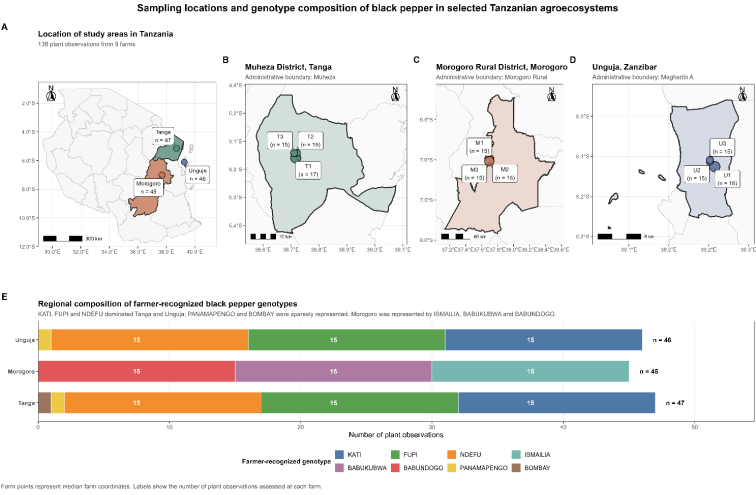
A total of 138 mature black pepper vines were evaluated across nine farms. Morogoro contributed 45 vines, Tanga 47 and Zanzibar 46. BABUKUBWA, BABUNDOGO and ISMAILIA were each represented by 15 vines, while FUPI, KATI and NDEFU were each represented by 30 vines. BOMBAY and PANAMAPENGO were represented by one and two vines, respectively, and were therefore retained only for descriptive presentation. Genotype representation was geographically unbalanced. BABUKUBWA, BABUNDOGO and ISMAILIA were evaluated only in Morogoro, whereas FUPI, KATI and NDEFU were represented in Tanga and Zanzibar. (
Figure 1).
Figure 1. Study locations and representation of farmer-recognized black pepper genotypes across sampled farms in Morogoro Rural, Muheza and Magharibi A districts, Tanzania.
3.2. Quantitative Phenotypic and Yield-Component Differentiation
Farmer-recognized genotypes differed across the quantitative traits evaluated. The strongest genotype-associated differentiation occurred in spike length (F = 171.94, p < 0.001, partial η2 = 0.954), number of spikes per kilogram (F = 42.09, p < 0.001, partial η2 = 0.927), berry length (F = 62.96, p < 0.001, partial η2 = 0.901), berry-size index (F = 35.71, p < 0.001, partial η2 = 0.813) and leaf-size index (F = 33.79, p < 0.001, partial η2 = 0.796). These effects indicate strong separation among sampled genotype groups but do not independently establish genetic control.
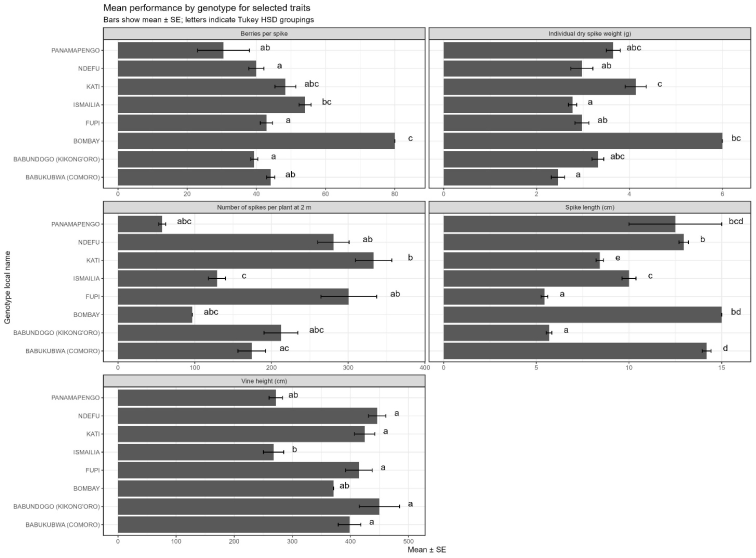
Vegetative characteristics varied among genotypes. BABUNDOGO had the greatest estimated mean vine height at 449.9 cm, followed by NDEFU at 446.1 cm, KATI at 424.6 cm and FUPI at 414.7 cm. ISMAILIA had the lowest estimated mean vine height at 267.7 cm (
Figure 2). BABUKUBWA had the largest leaves, with mean leaf length and width of 14.69 and 8.67 cm, respectively, whereas NDEFU had intermediate values of 12.82 and 7.77 cm. The remaining principal genotypes had comparatively smaller leaf dimensions.
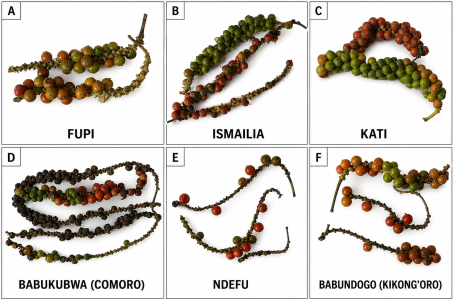
Reproductive differentiation was particularly evident in spike architecture. BABUKUBWA had the longest spikes, with an estimated mean of 14.19 cm, followed by NDEFU at 12.95 cm. By contrast, BABUNDOGO and FUPI had substantially shorter spikes, averaging 5.69 and 5.44 cm, respectively. ISMAILIA produced the highest number of berries per spike at 54.1, followed by KATI at 48.4 berries per spike (
Figure 2 and 3).
Spike- and berry-weight traits followed a different pattern from spike length. KATI had the greatest mean individual dry spike weight at 4.13 g, followed by BABUNDOGO at 3.32 g, FUPI at 2.98 g and NDEFU at 2.97 g. Despite its long spikes, BABUKUBWA had the lowest dry spike weight among the six principal types at 2.46 g. Fresh weight of 100 spikes was highest in BABUNDOGO at 393.3 g, followed by KATI at 382.1 g and FUPI at 350.8 g. NDEFU and KATI had the greatest fresh weights of 1,000 berries at 161.3 and 159.2 g, respectively. BABUKUBWA had the largest number of spikes per kilogram at 199.1, reflecting lighter individual spikes rather than superior productivity (
Figure 2).
Figure 2. Estimated mean performance of farmer-recognized black pepper genotypes in vine, leaf, spike and berry traits.
Figure 3. Representative spike and berry morphology of farmer-recognized black pepper genotypes grown in selected Tanzanian production environments.
3.3. Farm-Level Contribution to Trait Expression
Farm-level clustering varied among traits. The largest reported intraclass correlation coefficients (ICC) occurred for number of spikes per kilogram (ICC = 0.676) and fresh weight of 1,000 berries (ICC = 0.638). Clustering was also evident for individual fresh spike weight (ICC = 0.508), vine height (ICC = 0.464), number of spikes recorded at 2 m height (ICC = 0.440) and individual dry spike weight (ICC = 0.363). Berry length, leaf length and spike length showed comparatively little residual farm-level clustering after fitting the genotype effect.
These estimates indicate that several vigour and reproductive-mass traits were responsive to farm-level conditions. However, the ICC values do not identify the specific causes of variation, which could include soil fertility, shade, support trees, vine age, management, microclimate or unmeasured disease pressure.
3.4. Qualitative Phenotypic Differentiation
Farmer-recognized genotypes showed strong associations with several qualitative descriptors. The largest association was observed for spike shape (Cramér’s V = 0.909), followed by spike setting (V = 0.806), leaf shape (V = 0.777), branching habit (V = 0.745) and leaf-venation pattern (V = 0.667). The reported tests for these descriptors had p < 0.001. Spike orientation showed a weaker association (V = 0.402, p = 0.013), while berry shape showed limited differentiation (V = 0.284, p = 0.062).
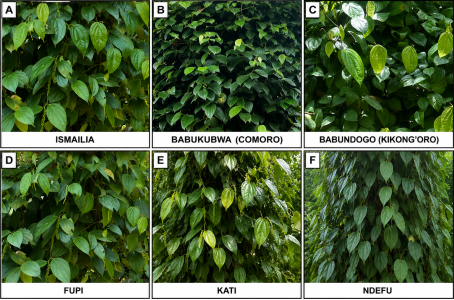
BABUKUBWA was consistently characterized by erect branching, cordate leaves, campylodromous venation, loose spike setting and filiform spikes. BABUNDOGO was also erect but differed through compact cylindrical spikes. ISMAILIA was predominantly erect and ovate-elliptic and had filiform spikes. FUPI was associated mainly with hanging branching and compact cylindrical spikes; KATI with horizontal branching, ovate leaves and compact spike setting; and NDEFU with horizontal branching, campylodromous venation and predominantly medium-loose spike setting. Prostrate or pendant spikes and round berries predominated across types and were less informative for differentiation (
Table 2;
Figure 4).
Table 2. Dominant qualitative descriptor states of farmer-recognized black pepper genotypes.
Type | Branching habit | Leaf shape | Leaf venation | Spike setting | Spike shape |
BABUKUBWA | Erect, 100% | Cordate, 100% | Campylodromous, 100% | Loose, 100% | Filiform, 100% |
BABUNDOGO | Erect, 100% | Ovate, 66.7% | Acrodromous, 66.7% | Compact, 100% | Cylindrical, 100% |
ISMAILIA | Erect, 66.7% | Ovate-elliptic, 66.7% | Acrodromous, 66.7% | Medium-loose, 66.7% | Filiform, 100% |
FUPI | Hanging/pendant, 66.7% | Ovate-elliptic, 66.7% | Campylodromous, 66.7% | Compact, 83.3% | Cylindrical, 83.3% |
KATI | Horizontal, 83.3% | Ovate, 100% | Acrodromous, 83.3% | Compact, 83.3% | Filiform, 100% |
NDEFU | Horizontal, 83.3% | Ovate, 83.3% | Campylodromous, 100% | Medium-loose, 83.3% | Filiform, 96.7% |
Figure 4. Representative leaf and canopy phenotypes of farmer-recognized black pepper genotypes.
3.5. Associations Among Quantitative Traits
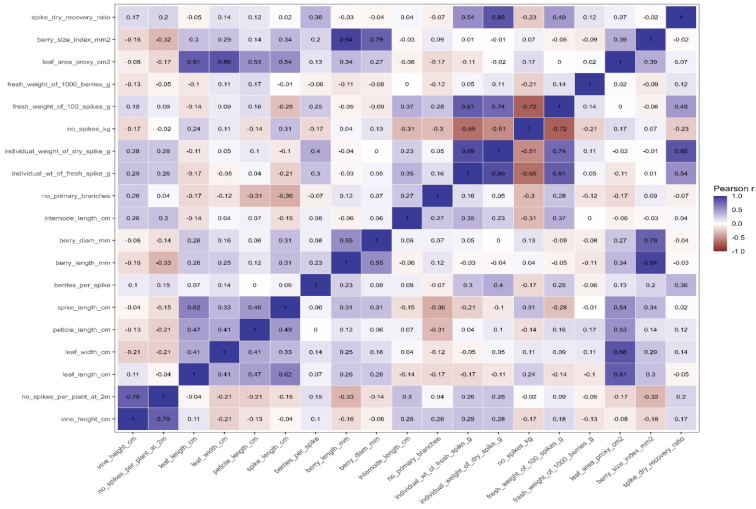
Figure 5. Pearson correlation matrix for vine-level quantitative morphological and yield-component traits.
Several strong correlations were observed among vegetative, spike and berry traits. Individual fresh spike weight was strongly positively correlated with individual dry spike weight, r = 0.892, while individual dry spike weight was positively correlated with fresh weight of 100 spikes, r = 0.741. Vine height was strongly correlated with the number of spikes recorded at 2 m height, r = 0.791. Moderate positive correlations occurred between berry length and berry diameter, r = 0.554, and between leaf length and leaf width, r = 0.408.
The number of spikes per kilogram was negatively correlated with fresh weight of 100 spikes, r = −0.725, and individual fresh spike weight, r = −0.651. These relationships were expected because fewer heavy spikes, but more light spikes, are required to constitute one kilogram. Similarly, the strong relationships among individual fresh spike weight, individual dry spike weight and fresh weight of 100 spikes partly reflected their shared measurement basis. The correlations therefore indicate consistency among related spike-mass measures rather than entirely independent biological relationships (
Figure 5).
3.6. Multivariate Differentiation of Farmer-Recognized Black Pepper Genotypes
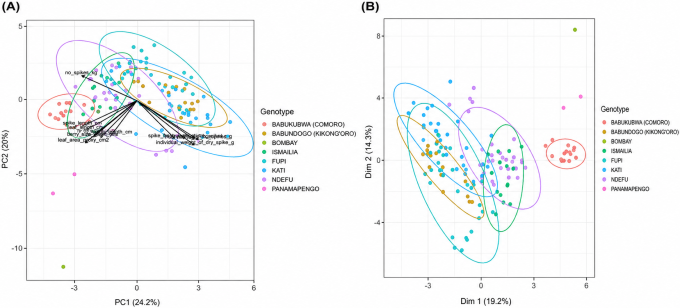
The first two principal components explained 44.2% of total variation in the quantitative traits. PC1 accounted for 24.2%, while PC2 accounted for 20.0%. Traits contributing strongly to the PC1-PC2 ordination included individual dry and fresh spike weights, fresh weight of 100 spikes, leaf-size index, berry-size index, leaf length, spike dry-recovery ratio, spike length and number of spikes per kilogram (
Figure 6). BABUKUBWA occupied the long-spiked, broad-leaved portion of the ordination but had comparatively light individual spikes. KATI and BABUNDOGO were associated more strongly with spike mass, NDEFU combined relatively long spikes with high 1,000-berry weight, and ISMAILIA was characterized principally by high berry number.
Factor analysis of mixed data showed that Dimensions 1 and 2 explained 19.2% and 14.3% of the combined quantitative and qualitative variation, respectively, giving a cumulative contribution of 33.5%. Variables contributing strongly included spike length, leaf-size index, leaf length, individual dry spike weight, fresh weight of 100 spikes, spike dry-recovery ratio and branching habit. The mixed-data ordination therefore supported the quantitative PCA by showing that differentiation arose from integrated combinations of leaf architecture, branching pattern, spike morphology and reproductive mass (
Figure 6).
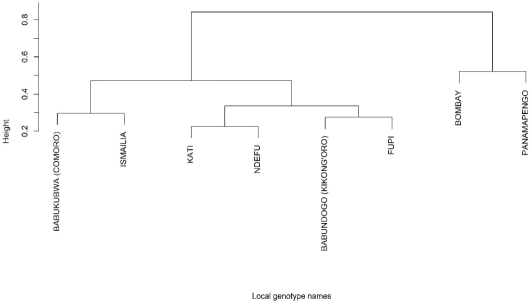
Gower-distance clustering broadly reflected integrated phenotypic profiles. PERMANOVA indicated separation among farmer-recognized genotype groups (R2 = 0.588, pseudo-F = 26.51, p = 0.001). This statistic describes genotype-group structure in the observed mixed phenotype dataset; because several types were geographically restricted, it may also include environmental structuring. The multivariate results do not establish pedigree or genetic relatedness.
Figure 6. Multivariate phenotypic differentiation among farmer-recognized black pepper genotypes: (A) principal component analysis of standardized quantitative traits and (B) factor analysis of mixed quantitative and qualitative descriptors. Ellipses summarize within-group dispersion and do not represent genetic populations.
Figure 7. Hierarchical clustering of farmer-recognized black pepper genotypes using Gower dissimilarities calculated from mixed morphological and yield-component descriptors. The dendrogram represents phenotypic similarity, not genetic relatedness.
3.7. Soil Variability Across Sampled Farms
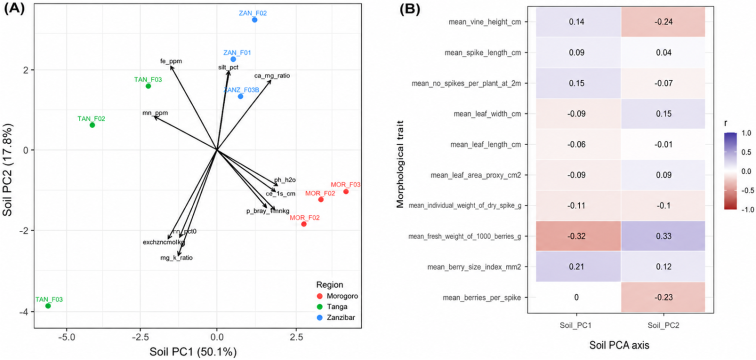
The first two soil principal components explained 67.8% of variation among the nine sampled farms. Soil PC1 accounted for 50.1%, while Soil PC2 accounted for 17.8% (
Figure 8). Variables with large contributions to Soil PC1 represented broad soil-fertility and chemical gradients, including organic carbon, available phosphorus, electrical conductivity, soil pH and exchangeable nutrient components. Soil PC2 was influenced mainly by magnesium-related ratios, exchangeable magnesium, zinc, iron and texture components. The results indicated substantial edaphic heterogeneity among the sampled farms.
Exploratory soil-morphology association analysis identified limited but biologically suggestive relationships. Fresh weight of 1000 berries was negatively associated with Soil PC1, r = −0.320, p = 0.018, and positively associated with Soil PC2, r = 0.327, p = 0.016 (
Figure 8). Because only one independent composite soil sample was available per farm, soil-morphology relationships were not used for confirmatory inference and regarded as exploratory.
Figure 8. Soil variability and exploratory soil-morphology relationships across black pepper study farms. (A) Soil PCA based on standardized edaphic variables. (B) Correlation heatmap between soil PC trait scores.
4. Discussion
4.1. Morphological Differentiation and Descriptor Value
The strong differentiation observed in structural and reproductive descriptors indicates that farmer-recognized genotypes corresponded to coherent, observable phenotypic profiles. Spike shape and setting, leaf shape, branching habit and venation were particularly informative qualitative descriptors, while spike length, berry dimensions and leaf-size index provided strong quantitative separation. These findings support the use of standardized morphological descriptors as a first-stage tool for germplasm identification and nursery traceability. The value of combining leaf, branching, spike and berry descriptors has been demonstrated in black pepper characterization studies from Malaysia, Indonesia and India, where cultivated accessions were distinguished more effectively through integrated trait profiles than by single characters
| [2] | Prakash K, Joseph J, Santhoshkumar A, Puthiamadom N. Morphological characterization of black pepper (Piper nigrum L.) accessions from Kerala. Indian Journal of Plant Genetic Resources. 2020; 33(3): 352-359.
https://doi.org/10.5958/0976-1926.2020.00049.2 |
| [11] | Chen YS, Dayod M, Tawan CS. Phenetic analysis of cultivated black pepper (Piper nigrum L.) in Malaysia. International Journal of Agronomy. 2018; 2018: 3894924.
https://doi.org/10.1155/2018/3894924 |
| [12] | Prayoga GI, Ropalia, Aini SN, Mustikarini ED, Rosalin Y. Diversity of black pepper plant (Piper nigrum) in Bangka Island, Indonesia, based on agro-morphological characters. Biodiversitas. 2020; 21(2): 652-660.
https://doi.org/10.13057/biodiv/d210230 |
| [14] | Preethy TT, Aswathy TS, Sathyan T, Dhanya MK, Murugan M. Performance, diversity analysis and character association of black pepper (Piper nigrum L.) accessions in the high altitude of Idukki District, Kerala. Journal of Spices and Aromatic Crops. 2018; 27(1): 17-21.
https://doi.org/10.25081/josac.2018.v27.i1.1010 |
[2, 11, 12, 14]
. The present results also extend earlier Tanzanian work: BABUKUBWA again expressed a long-spiked and broad-leaved phenotype, BABUNDOGO retained a shorter and more compact spike profile, and ISMAILIA produced the greatest number of berries per spike
| [8] | Shango AJ, Majubwa RO, Maerere AP. Morphological characterization and yield of pepper (Piper nigrum L.) types grown in Morogoro District, Tanzania. CABI Agriculture and Bioscience. 2021; 2: 6. https://doi.org/10.1186/s43170-021-00028-9 |
[8]
.
The recurrence of these characteristics across studies suggests that some descriptors may be comparatively persistent. However, similarity between studies does not demonstrate genetic uniformity. Morphological expression may vary with vine age, shade, support-tree characteristics, soil fertility, crop management and seasonal conditions
| [15] | Yap CA. Impact of different fertilization methods on the soil, yield and growth performance of black pepper (Piper nigrum L.). Malaysian Journal of Soil Science. 2012; 16: 71-87. |
| [16] | Bermawie N, Wahyuni S, Heryanto R, Darwati I. Morphological characteristics, yield and quality of black pepper Ciinten variety in three agroecological conditions. IOP Conference Series: Earth and Environmental Science. 2019; 292(1): 012065.
https://doi.org/10.1088/1755-1315/292/1/012065 |
| [17] | Yudiyanto, Rizali A, Munif A, Setiadi D, Qayim I. Environmental factors affecting productivity of two Indonesian varieties of black pepper (Piper nigrum L.). AGRIVITA Journal of Agricultural Science. 2014; 36(3): 278-284.
https://doi.org/10.17503/Agrivita-2014-36-3-278-284 |
[15-17]
. Farmer nomenclature is therefore a useful starting point for germplasm investigation but not definitive evidence of cultivar identity. Molecular studies have shown that visible differentiation, geographical origin and genetic relatedness do not always coincide in black pepper. Indian cultivars have been separated using RAPD and microsatellite markers, demonstrating genuine molecular differentiation among some named materials
| [30] | Joy N, Abraham Z, Soniya EV. A preliminary assessment of genetic relationships among agronomically important cultivars of black pepper. BMC Genetics. 2007; 8: 42.
https://doi.org/10.1186/1471-2156-8-42 |
| [31] | Joy N, Prasanth VP, Soniya EV. Microsatellite-based analysis of genetic diversity of popular black pepper genotypes in South India. Genetica. 2011; 139(8): 1033-1043.
https://doi.org/10.1007/s10709-011-9605-x |
| [32] | Kumari R, Wankhede DP, Bajpai A, Maurya A, Prasad K, Gautam D, Rangan P, Latha M, John JK, Suma A, Bhat KV, Gaikwad AB. Genome-wide identification and characterization of microsatellite markers in black pepper (Piper nigrum): A valuable resource for boosting genomics applications. PLOS ONE. 2019; 14(12): e0226002.
https://doi.org/10.1371/journal.pone.0226002 |
[30-32]
. In contrast, high-density SNP analysis of 175 Sri Lankan accessions identified little geographical genetic structure despite sampling across eight agroclimatic regions
| [33] | Wimalarathna NA, Wickramasuriya AM, Metschina D, Cauz-Santos LA, Bandupriya D, Ariyawansa KGSU, Gopallawa B, Chase MW, Samuel R, Silva TD. Genetic diversity and population structure of Piper nigrum accessions based on next-generation SNP markers. PLOS ONE. 2024; 19(6): e0305990.
https://doi.org/10.1371/journal.pone.0305990 |
[33]
.
4.2. Yield-Component Architecture and Selection Implications
The separation between spike length and spike mass was a central biological finding. BABUKUBWA produced the longest spikes and largest leaves but had comparatively light individual dry spikes. KATI and BABUNDOGO had shorter spikes but stronger spike-weight attributes. ISMAILIA expressed the greatest number of berries per spike, while NDEFU and KATI had high 1,000-berry mass. Long spikes should therefore not be treated automatically as indicators of superior yield potential. Marketable dry production depends on the number of productive spikes, berries per spike, individual berry mass, and fresh-to-dry recovery. A shorter compact spike with well-developed berries may produce more marketable dry matter than a long but sparsely filled or lightweight spike. Selection based solely on visually attractive long spikes could overlook materials carrying favourable berry-mass or spike-weight traits. Similar multi-trait yield architecture has been reported in other black pepper germplasm evaluations
| [13] | Paul R, Ajith PM, Anuprasad TE. Contribution of spike and berry characters for yield in promising genotypes of black pepper (Piper nigrum L.). Journal of Applied Horticulture. 2024; 26(3): 310-313. https://doi.org/10.37855/jah.2024.v26i03.59 |
| [14] | Preethy TT, Aswathy TS, Sathyan T, Dhanya MK, Murugan M. Performance, diversity analysis and character association of black pepper (Piper nigrum L.) accessions in the high altitude of Idukki District, Kerala. Journal of Spices and Aromatic Crops. 2018; 27(1): 17-21.
https://doi.org/10.25081/josac.2018.v27.i1.1010 |
| [16] | Bermawie N, Wahyuni S, Heryanto R, Darwati I. Morphological characteristics, yield and quality of black pepper Ciinten variety in three agroecological conditions. IOP Conference Series: Earth and Environmental Science. 2019; 292(1): 012065.
https://doi.org/10.1088/1755-1315/292/1/012065 |
[13, 14, 16]
.
The contrasting profiles suggest that no single genotype possessed all desirable characteristics. The materials should be viewed as sources of complementary traits rather than ranked immediately as superior or inferior cultivars. Future selection should focus on independently meaningful endpoints, particularly total fresh and dry yield per vine, dry recovery, marketable grade and stability across harvests. Selection based only on fresh mass could therefore favour water-rich material rather than genuinely greater marketable dry matter. Yield-component research in black pepper has also shown that the relevance of a trait can change according to whether the endpoint is fresh berry yield, dry pepper yield or quality-adjusted economic yield
| [13] | Paul R, Ajith PM, Anuprasad TE. Contribution of spike and berry characters for yield in promising genotypes of black pepper (Piper nigrum L.). Journal of Applied Horticulture. 2024; 26(3): 310-313. https://doi.org/10.37855/jah.2024.v26i03.59 |
| [14] | Preethy TT, Aswathy TS, Sathyan T, Dhanya MK, Murugan M. Performance, diversity analysis and character association of black pepper (Piper nigrum L.) accessions in the high altitude of Idukki District, Kerala. Journal of Spices and Aromatic Crops. 2018; 27(1): 17-21.
https://doi.org/10.25081/josac.2018.v27.i1.1010 |
[13, 14]
.
4.3. Farm Environment and Trait-Expression
Farm-level clustering was substantial for number of spikes per kilogram, 1,000-berry weight, individual fresh spike weight, vine height, spike number at 2 m and individual dry spike weight. These traits are related to vigour, reproductive loading and biomass accumulation and are likely to be sensitive to vine age, soil fertility, moisture availability, shade, support-tree species, pruning, nutrition, disease pressure and microclimate
| [15] | Yap CA. Impact of different fertilization methods on the soil, yield and growth performance of black pepper (Piper nigrum L.). Malaysian Journal of Soil Science. 2012; 16: 71-87. |
| [16] | Bermawie N, Wahyuni S, Heryanto R, Darwati I. Morphological characteristics, yield and quality of black pepper Ciinten variety in three agroecological conditions. IOP Conference Series: Earth and Environmental Science. 2019; 292(1): 012065.
https://doi.org/10.1088/1755-1315/292/1/012065 |
| [17] | Yudiyanto, Rizali A, Munif A, Setiadi D, Qayim I. Environmental factors affecting productivity of two Indonesian varieties of black pepper (Piper nigrum L.). AGRIVITA Journal of Agricultural Science. 2014; 36(3): 278-284.
https://doi.org/10.17503/Agrivita-2014-36-3-278-284 |
[15-17]
. By comparison, spike length, leaf length and berry length showed less residual farm-level clustering after fitting the genotype effect. This may indicate that some structural traits are relatively more consistent than vigour or biomass traits, although stability must still be tested in balanced trials. Because several genotypes were geographically restricted, genotype and study area were partly confounded. The present study cannot make a complete genetic-environmental partition or estimate type × environment interaction. A balanced multi-environment clonal trial is required in which the same verified accessions are established across locations using standardized planting material and management.
4.4. Multivariate Profiles and the Meaning of Local Names
PCA, factor analysis of mixed data, Gower clustering and PERMANOVA consistently indicated that sampled genotypes differed through integrated phenotype profiles rather than a single dominant trait. The moderate proportion of total variation explained by the first two axes reflects the multidimensional nature of the phenotype, which combined vegetative architecture, leaf form, branching habit, spike structure, berry loading and reproductive mass.
The multivariate analyses are valuable because they reveal how traits occur together. Nevertheless, PERMANOVA separation and Gower clustering represent phenotypic group structure and similarity, not genetic population structure or pedigree. Molecular studies illustrate why this distinction matters: marker analyses have identified differentiation among some named cultivars, whereas high-density SNP analysis of Sri Lankan accessions found limited correspondence between geography and genetic structure
| [30] | Joy N, Abraham Z, Soniya EV. A preliminary assessment of genetic relationships among agronomically important cultivars of black pepper. BMC Genetics. 2007; 8: 42.
https://doi.org/10.1186/1471-2156-8-42 |
| [31] | Joy N, Prasanth VP, Soniya EV. Microsatellite-based analysis of genetic diversity of popular black pepper genotypes in South India. Genetica. 2011; 139(8): 1033-1043.
https://doi.org/10.1007/s10709-011-9605-x |
| [32] | Kumari R, Wankhede DP, Bajpai A, Maurya A, Prasad K, Gautam D, Rangan P, Latha M, John JK, Suma A, Bhat KV, Gaikwad AB. Genome-wide identification and characterization of microsatellite markers in black pepper (Piper nigrum): A valuable resource for boosting genomics applications. PLOS ONE. 2019; 14(12): e0226002.
https://doi.org/10.1371/journal.pone.0226002 |
| [33] | Wimalarathna NA, Wickramasuriya AM, Metschina D, Cauz-Santos LA, Bandupriya D, Ariyawansa KGSU, Gopallawa B, Chase MW, Samuel R, Silva TD. Genetic diversity and population structure of Piper nigrum accessions based on next-generation SNP markers. PLOS ONE. 2024; 19(6): e0305990.
https://doi.org/10.1371/journal.pone.0305990 |
[30-33]
. Morphology and molecular identity are complementary but not interchangeable forms of evidence.
4.5. Implications for Conservation, Breeding and Seed Systems
The observed phenotypic differentiation indicates that farmer fields contain potentially valuable black pepper materials that should be documented before they are lost through vine ageing, disease, drought, replacement or unregulated planting-material exchange. Conservation should not be based only on local names. Several representative vines should be sampled where within-name variation occurs, and each collected clonal line should receive a unique accession identifier accompanied by geographic coordinates, source history, descriptor profile, photographs, plant-health status and farmer knowledge.
The contrasting profiles provide a basis for prioritizing accessions for further evaluation, but breeding value cannot be inferred solely from morphological or component measurements. Candidate accessions must also be assessed for genetic distinctness, disease response, total yield per vine, dry recovery, piperine, essential oil, oleoresin, marketable grade, propagation performance and stability across environments. Morphological descriptors may support mother-vine identification and nursery labels, but reliable planting-material systems should combine unique accession labeling, molecular identity testing, and nursery traceability
| [9] | Gatto M, Le PD, Pacillo G, Maredia M, Hareau G, Spielman DJ. Policy options for advancing seed systems for vegetatively propagated crops in Vietnam. Journal of Crop Improvement. 2021; 35(6): 763-789.
https://doi.org/10.1080/15427528.2021.1881011 |
[9]
.
4.6. Study Limitations and Future Research
The study evaluated established farmer fields rather than a controlled common garden, so observed differences reflected both genotype-associated characteristics and prevailing farm conditions. Genotype and study area were partly confounded because several genotypes were geographically restricted. Only nine independent composite soil samples were available, limiting soil-phenotype inference. Measurements were made during one assessment period, and temporal stability remains unknown. Future research should prioritize accession-level molecular characterization, balanced multi-environment clonal trials, repeated measurement of total fresh and dry yield, disease and pest phenotyping, biochemical quality analysis, nursery-performance assessment and, larger soil and management studies.
5. Conclusion
This study documented substantial quantitative and qualitative phenotypic differentiation among farmer-recognized black pepper genotypes sampled from Morogoro, Tanga and Unguja. The strongest genotype-associated differentiation occurred in spike length, berry dimensions, leaf-size index, number of spikes per kilogram and qualitative descriptors including spike shape, spike setting, leaf shape, branching habit and leaf venation. The sampled materials expressed contrasting and multidimensional profiles. BABUKUBWA combined long spikes and large leaves with comparatively light dry spikes; BABUNDOGO expressed short compact spikes and favourable spike-mass attributes; ISMAILIA produced the greatest number of berries per spike; KATI combined high dry spike weight with relatively high berry number and berry mass; NDEFU combined long spikes, vigour and high 1,000-berry weight; and FUPI was characterized by short compact spikes and predominantly hanging branching.
These contrasts demonstrate that reproductive performance cannot be inferred from spike length or vegetative vigour alone. Selection should use integrated profiles combining spike number, berry number, berry size, spike compactness, spike mass and dry recovery. Farm-level clustering indicated that performance was influenced by production environment as well as genotype. The multivariate analyses supported coherent phenotypic groupings but did not establish genetic relatedness. The main contribution of the study is therefore a phenotype-based framework for documenting, comparing and prioritizing candidate black pepper germplasm. The materials should presently be regarded as candidate germplasm resources rather than formally validated cultivars.
6. Recommendations
Representative vines should be collected and documented using coordinates, farmer-recognized names, source history, and descriptor profiles.
Accessions should undergo molecular characterization to test for distinctness, synonyms, homonyms, mixtures and within-name variation.
Verified accessions should be established in replicated common-garden and multi-environment clonal trials to estimate accession, environment and accession × environment effects.
Quality assessment should include piperine, essential oil, oleoresin, bulk density, moisture, drying efficiency, cleanliness and marketable grade.
Soil and management studies should be repeated across more independent farms with replicated soil sampling.
Abbreviations
DUS | Distinctness, Uniformity and Stability |
PERMANOVA | Permutational Multivariate Analysis of Variance |
PPV&FRA | Protection of Plant Varieties and Farmers’ Rights Authority |
SUA | Sokoine University of Agriculture |
TARI | Tanzania Agricultural Research Institute |
Acknowledgments
The authors gratefully acknowledge Mr. Stephen A. Ruvuga and Mr. Yasini H. Sanju for their valuable technical assistance. The authors also appreciate the cooperation of the participating black pepper farmers and local agricultural officers in the study areas.
Author Contributions
Stephano Joseph Kayala: Conceptualization, Data curation, Formal Analysis, Investigation, Methodology, Resources, Visualization, Writing – original draft
Luseko Amos Chilagane: Conceptualization, Methodology, Supervision, Validation, Writing – review & editing
Ramadhani Omari Majubwa: Conceptualization, Methodology, Supervision, Validation, Writing – review & editing
Funding
This research received financial support for data collection activities from the AgroEcology Fund through Mtandao wa Vikundi vya Wakulima Tanzania (MVIWATA).
Conflicts of Interest
The authors declare no conflicts of interest.
References
| [1] |
Gorgani L, Mohammadi M, Najafpour GD, Nikzad M. Piperine—the bioactive compound of black pepper: From isolation to medicinal formulations. Critical Reviews in Food Science and Nutrition. 2017; 57(15): 3308-3320.
https://doi.org/10.1080/10408398.2015.1072041
|
| [2] |
Prakash K, Joseph J, Santhoshkumar A, Puthiamadom N. Morphological characterization of black pepper (Piper nigrum L.) accessions from Kerala. Indian Journal of Plant Genetic Resources. 2020; 33(3): 352-359.
https://doi.org/10.5958/0976-1926.2020.00049.2
|
| [3] |
Reshma P, Sreekala GS, Nair DS, Stephen R. Genetic diversity assessment of black pepper (Piper nigrum L.) cultivars of the Western Ghats. Plant Science Today. 2024; 11(1): 216-229.
https://doi.org/10.14719/pst.4816
|
| [4] |
Jha TB. Karyotype analysis from aerial roots of Piper nigrum based on Giemsa and fluorochrome banding. Cytologia. 2019; 84(4): 313-317.
https://doi.org/10.1508/cytologia.84.313
|
| [5] |
Reyes T, Quiroz R, Luukkanen O, de Mendiburu F. Spice crops agroforestry systems in the East Usambara Mountains, Tanzania: Growth analysis. Agroforestry Systems. 2009; 76(3): 513-523.
https://doi.org/10.1007/s10457-009-9210-5
|
| [6] |
Ngolle A, Salehe FS. Economic contribution of spice farming to household income on the slopes of the Uluguru Mountains, Morogoro Region, Tanzania. Tanzania Journal of Agricultural Sciences. 2024; 23(2): 351-365.
|
| [7] |
International Trade Centre. Tanzania spices sub-sector strategy. Geneva: International Trade Centre; 2014.
|
| [8] |
Shango AJ, Majubwa RO, Maerere AP. Morphological characterization and yield of pepper (Piper nigrum L.) types grown in Morogoro District, Tanzania. CABI Agriculture and Bioscience. 2021; 2: 6.
https://doi.org/10.1186/s43170-021-00028-9
|
| [9] |
Gatto M, Le PD, Pacillo G, Maredia M, Hareau G, Spielman DJ. Policy options for advancing seed systems for vegetatively propagated crops in Vietnam. Journal of Crop Improvement. 2021; 35(6): 763-789.
https://doi.org/10.1080/15427528.2021.1881011
|
| [10] |
Shango AJ, Majubwa RO, Maerere AP. Extent of spike shedding and stem wilting of pepper (Piper nigrum L.) in Morogoro District, Tanzania. CABI Agriculture and Bioscience. 2020; 1: 6.
https://doi.org/10.1186/s43170-020-00006-7
|
| [11] |
Chen YS, Dayod M, Tawan CS. Phenetic analysis of cultivated black pepper (Piper nigrum L.) in Malaysia. International Journal of Agronomy. 2018; 2018: 3894924.
https://doi.org/10.1155/2018/3894924
|
| [12] |
Prayoga GI, Ropalia, Aini SN, Mustikarini ED, Rosalin Y. Diversity of black pepper plant (Piper nigrum) in Bangka Island, Indonesia, based on agro-morphological characters. Biodiversitas. 2020; 21(2): 652-660.
https://doi.org/10.13057/biodiv/d210230
|
| [13] |
Paul R, Ajith PM, Anuprasad TE. Contribution of spike and berry characters for yield in promising genotypes of black pepper (Piper nigrum L.). Journal of Applied Horticulture. 2024; 26(3): 310-313.
https://doi.org/10.37855/jah.2024.v26i03.59
|
| [14] |
Preethy TT, Aswathy TS, Sathyan T, Dhanya MK, Murugan M. Performance, diversity analysis and character association of black pepper (Piper nigrum L.) accessions in the high altitude of Idukki District, Kerala. Journal of Spices and Aromatic Crops. 2018; 27(1): 17-21.
https://doi.org/10.25081/josac.2018.v27.i1.1010
|
| [15] |
Yap CA. Impact of different fertilization methods on the soil, yield and growth performance of black pepper (Piper nigrum L.). Malaysian Journal of Soil Science. 2012; 16: 71-87.
|
| [16] |
Bermawie N, Wahyuni S, Heryanto R, Darwati I. Morphological characteristics, yield and quality of black pepper Ciinten variety in three agroecological conditions. IOP Conference Series: Earth and Environmental Science. 2019; 292(1): 012065.
https://doi.org/10.1088/1755-1315/292/1/012065
|
| [17] |
Yudiyanto, Rizali A, Munif A, Setiadi D, Qayim I. Environmental factors affecting productivity of two Indonesian varieties of black pepper (Piper nigrum L.). AGRIVITA Journal of Agricultural Science. 2014; 36(3): 278-284.
https://doi.org/10.17503/Agrivita-2014-36-3-278-284
|
| [18] |
Zu C, Li Z, Yang J, Yu H, Sun Y, Tang H, Yost R, Wu H. Acid soil is associated with reduced yield, root growth and nutrient uptake in black pepper (Piper nigrum L.). Agricultural Sciences. 2014; 5(5): 466-473.
https://doi.org/10.4236/as.2014.55047
|
| [19] |
Gee GW, Bauder JW. Particle-size analysis. In: Klute A, editor. Methods of soil analysis. Part 1: Physical and mineralogical methods. 2nd ed. Madison, WI: American Society of Agronomy and Soil Science Society of America; 1986. p. 383-411.
https://doi.org/10.2136/sssabookser5.1.2ed.c15
|
| [20] |
McLean EO. Soil pH and lime requirement. In: Page AL, Miller RH, Keeney DR, editors. Methods of soil analysis. Part 2: Chemical and microbiological properties. 2nd ed. Madison, WI: American Society of Agronomy and Soil Science Society of America; 1982. p. 199-224.
https://doi.org/10.2134/agronmonogr9.2.2ed.c12
|
| [21] |
Thomas GW. Exchangeable cations. In: Page AL, Miller RH, Keeney DR, editors. Methods of soil analysis. Part 2: Chemical and microbiological properties. 2nd ed. Madison, WI: American Society of Agronomy and Soil Science Society of America; 1982. p. 159-165.
https://doi.org/10.2134/agronmonogr9.2.2ed.c9
|
| [22] |
Bray RH, Kurtz LT. Determination of total, organic, and available forms of phosphorus in soils. Soil Science. 1945; 59(1): 39-45.
https://doi.org/10.1097/00010694-194501000-00006
|
| [23] |
Nelson DW, Sommers LE. Total carbon, organic carbon, and organic matter. In: Sparks DL, editor. Methods of soil analysis. Part 3: Chemical methods. Madison, WI: Soil Science Society of America; 1996. p. 961-1010.
https://doi.org/10.2136/sssabookser5.3.c34
|
| [24] |
Bremner JM. Nitrogen—total. In: Sparks DL, editor. Methods of soil analysis. Part 3: Chemical methods. Madison, WI: Soil Science Society of America; 1996. p. 1085-1121.
https://doi.org/10.2136/sssabookser5.3.c37
|
| [25] |
Lindsay WL, Norvell WA. Development of a DTPA soil test for zinc, iron, manganese, and copper. Soil Science Society of America Journal. 1978; 42(3): 421-428.
https://doi.org/10.2136/sssaj1978.03615995004200030009x
|
| [26] |
Gomez KA, Gomez AA. Statistical procedures for agricultural research. 2nd ed. New York: John Wiley & Sons; 1984.
|
| [27] |
International Plant Genetic Resources Institute. Descriptors for black pepper (Piper nigrum L.). Rome: International Plant Genetic Resources Institute; 1995.
|
| [28] |
Protection of Plant Varieties and Farmers’ Rights Authority. Guidelines for the conduct of test for distinctiveness, uniformity and stability on black pepper (Piper nigrum L.). New Delhi: Government of India; 2009.
|
| [29] |
Nakagawa S, Schielzeth H. A general and simple method for obtaining R2 from generalized linear mixed-effects models. Methods in Ecology and Evolution. 2013; 4(2): 133-142.
https://doi.org/10.1111/j.2041-210X.2012.00261.x
|
| [30] |
Joy N, Abraham Z, Soniya EV. A preliminary assessment of genetic relationships among agronomically important cultivars of black pepper. BMC Genetics. 2007; 8: 42.
https://doi.org/10.1186/1471-2156-8-42
|
| [31] |
Joy N, Prasanth VP, Soniya EV. Microsatellite-based analysis of genetic diversity of popular black pepper genotypes in South India. Genetica. 2011; 139(8): 1033-1043.
https://doi.org/10.1007/s10709-011-9605-x
|
| [32] |
Kumari R, Wankhede DP, Bajpai A, Maurya A, Prasad K, Gautam D, Rangan P, Latha M, John JK, Suma A, Bhat KV, Gaikwad AB. Genome-wide identification and characterization of microsatellite markers in black pepper (Piper nigrum): A valuable resource for boosting genomics applications. PLOS ONE. 2019; 14(12): e0226002.
https://doi.org/10.1371/journal.pone.0226002
|
| [33] |
Wimalarathna NA, Wickramasuriya AM, Metschina D, Cauz-Santos LA, Bandupriya D, Ariyawansa KGSU, Gopallawa B, Chase MW, Samuel R, Silva TD. Genetic diversity and population structure of Piper nigrum accessions based on next-generation SNP markers. PLOS ONE. 2024; 19(6): e0305990.
https://doi.org/10.1371/journal.pone.0305990
|
Cite This Article
-
APA Style
Kayala, S. J., Chilagane, L. A., Majubwa, R. O. (2026). Phenotypic Differentiation and Yield-Component of Farmer-Recognized Black Pepper (Piper nigrum L.) Genotypes in Selected Tanzanian Agroecosystems. International Journal of Applied Agricultural Sciences, 12(4), 152-165. https://doi.org/10.11648/j.ijaas.20261204.15
 Copy
|
Copy
|
 Download
ACS Style
Kayala, S. J.; Chilagane, L. A.; Majubwa, R. O. Phenotypic Differentiation and Yield-Component of Farmer-Recognized Black Pepper (Piper nigrum L.) Genotypes in Selected Tanzanian Agroecosystems. Int. J. Appl. Agric. Sci. 2026, 12(4), 152-165. doi: 10.11648/j.ijaas.20261204.15
Copy
|
Download
AMA Style
Kayala SJ, Chilagane LA, Majubwa RO. Phenotypic Differentiation and Yield-Component of Farmer-Recognized Black Pepper (Piper nigrum L.) Genotypes in Selected Tanzanian Agroecosystems. Int J Appl Agric Sci. 2026;12(4):152-165. doi: 10.11648/j.ijaas.20261204.15
Copy
|
Download
-
@article{10.11648/j.ijaas.20261204.15,
  author = {Stephano Joseph Kayala and Luseko Amos Chilagane and Ramadhani Omari Majubwa},
  title = {Phenotypic Differentiation and Yield-Component of Farmer-Recognized Black Pepper (Piper nigrum L.) Genotypes in Selected Tanzanian Agroecosystems},
  journal = {International Journal of Applied Agricultural Sciences},
  volume = {12},
  number = {4},
  pages = {152-165},
  doi = {10.11648/j.ijaas.20261204.15},
  url = {https://doi.org/10.11648/j.ijaas.20261204.15},
  eprint = {https://article.sciencepublishinggroup.com/pdf/10.11648.j.ijaas.20261204.15},
  abstract = {Black pepper (Piper nigrum L.) is an economically important perennial spice crop in Tanzania, but the identity, phenotypic distinctness and yield-component characteristics of farmer-maintained planting materials remain poorly documented. This study characterized farmer-recognized black pepper genotypes using integrated vegetative, leaf, spike, berry and reproductive-mass descriptors. An observational on-farm blocked characterization study was conducted across nine farms in Morogoro, Tanga and Unguja. A total of 138 mature vines were assessed for 28 descriptors, comprising nine qualitative and 19 quantitative traits. Vine-level quantitative data were analyzed using linear mixed-effects models that accounted for farm-level clustering. Qualitative descriptors were analyzed using Fisher’s exact tests with Monte Carlo simulation and Cramér’s V. Relationships among traits and integrated phenotypic structure were examined using correlation analysis, principal component analysis, factor analysis of mixed data, Gower-distance clustering and PERMANOVA. Soil variability among the nine farms was examined exploratorily using principal component analysis. Strong genotype-associated differentiation was observed for spike length (F = 171.94, p 2 = 0.954), number of spikes per kilogram (F = 42.09, p 2 = 0.927), berry length (F = 62.96, p 2 = 0.901), berry-size index (F = 35.71, p 2 = 0.813) and leaf-size index (F = 33.79, p 2 = 0.796). BABUKUBWA expressed the longest spikes and largest leaves but comparatively light dry spikes. KATI had the greatest individual dry spike weight, BABUNDOGO had the greatest fresh weight of 100 spikes, ISMAILIA produced the most berries per spike, and NDEFU and KATI had the greatest 1,000-berry mass. Qualitative differentiation was strongest for spike shape (V = 0.909), spike setting (V = 0.806), leaf shape (V = 0.777), branching habit (V = 0.745) and leaf venation (V = 0.667). Multivariate analyses indicated that differentiation reflected integrated combinations of vegetative and reproductive traits, while farm-level clustering was pronounced for several vigour and reproductive-mass traits. Farmer-recognized black pepper genotypes in the surveyed production environments possessed coherent and multidimensional phenotypic profiles. Spike length alone did not predict reproductive mass, demonstrating that selection should integrate spike number, berry number, berry size, spike mass and dry recovery. The identified materials provide candidate germplasm for conservation and further evaluation, but morphological differentiation does not confirm genetic distinctness. Molecular characterization, and balanced multi-environment clonal trials are required before the materials can be recognized as distinct cultivars or recommended for formal release.},
 year = {2026}
}
Copy
|
Download
-
TY  - JOUR
T1  - Phenotypic Differentiation and Yield-Component of Farmer-Recognized Black Pepper (Piper nigrum L.) Genotypes in Selected Tanzanian Agroecosystems
AU  - Stephano Joseph Kayala
AU  - Luseko Amos Chilagane
AU  - Ramadhani Omari Majubwa
Y1  - 2026/08/17
PY  - 2026
N1  - https://doi.org/10.11648/j.ijaas.20261204.15
DO  - 10.11648/j.ijaas.20261204.15
T2  - International Journal of Applied Agricultural Sciences
JF  - International Journal of Applied Agricultural Sciences
JO  - International Journal of Applied Agricultural Sciences
SP  - 152
EP  - 165
PB  - Science Publishing Group
SN  - 2469-7885
UR  - https://doi.org/10.11648/j.ijaas.20261204.15
AB  - Black pepper (Piper nigrum L.) is an economically important perennial spice crop in Tanzania, but the identity, phenotypic distinctness and yield-component characteristics of farmer-maintained planting materials remain poorly documented. This study characterized farmer-recognized black pepper genotypes using integrated vegetative, leaf, spike, berry and reproductive-mass descriptors. An observational on-farm blocked characterization study was conducted across nine farms in Morogoro, Tanga and Unguja. A total of 138 mature vines were assessed for 28 descriptors, comprising nine qualitative and 19 quantitative traits. Vine-level quantitative data were analyzed using linear mixed-effects models that accounted for farm-level clustering. Qualitative descriptors were analyzed using Fisher’s exact tests with Monte Carlo simulation and Cramér’s V. Relationships among traits and integrated phenotypic structure were examined using correlation analysis, principal component analysis, factor analysis of mixed data, Gower-distance clustering and PERMANOVA. Soil variability among the nine farms was examined exploratorily using principal component analysis. Strong genotype-associated differentiation was observed for spike length (F = 171.94, p 2 = 0.954), number of spikes per kilogram (F = 42.09, p 2 = 0.927), berry length (F = 62.96, p 2 = 0.901), berry-size index (F = 35.71, p 2 = 0.813) and leaf-size index (F = 33.79, p 2 = 0.796). BABUKUBWA expressed the longest spikes and largest leaves but comparatively light dry spikes. KATI had the greatest individual dry spike weight, BABUNDOGO had the greatest fresh weight of 100 spikes, ISMAILIA produced the most berries per spike, and NDEFU and KATI had the greatest 1,000-berry mass. Qualitative differentiation was strongest for spike shape (V = 0.909), spike setting (V = 0.806), leaf shape (V = 0.777), branching habit (V = 0.745) and leaf venation (V = 0.667). Multivariate analyses indicated that differentiation reflected integrated combinations of vegetative and reproductive traits, while farm-level clustering was pronounced for several vigour and reproductive-mass traits. Farmer-recognized black pepper genotypes in the surveyed production environments possessed coherent and multidimensional phenotypic profiles. Spike length alone did not predict reproductive mass, demonstrating that selection should integrate spike number, berry number, berry size, spike mass and dry recovery. The identified materials provide candidate germplasm for conservation and further evaluation, but morphological differentiation does not confirm genetic distinctness. Molecular characterization, and balanced multi-environment clonal trials are required before the materials can be recognized as distinct cultivars or recommended for formal release.
VL  - 12
IS  - 4
ER  -
Copy
|
Download





 Share This Article
 Twitter
 Linked In
 Facebook